
Best Polymarket Trading Strategies for Beginners in 2026
From manual edge trading to whale copying, here are the most profitable Polymarket strategies that actually work - even if you're just getting started.

The Reality of Trading Polymarket
Let's get something straight: Polymarket isn't a casino, but it's also not free money. The traders making consistent profits aren't just guessing - they have systems, do research, and manage risk like actual investors.
The good news? You don't need a finance degree or a trading bot to be profitable. You just need the right strategy for your skill level and time commitment.
Here are the five strategies that actually work in 2026, ranked from easiest to most advanced.
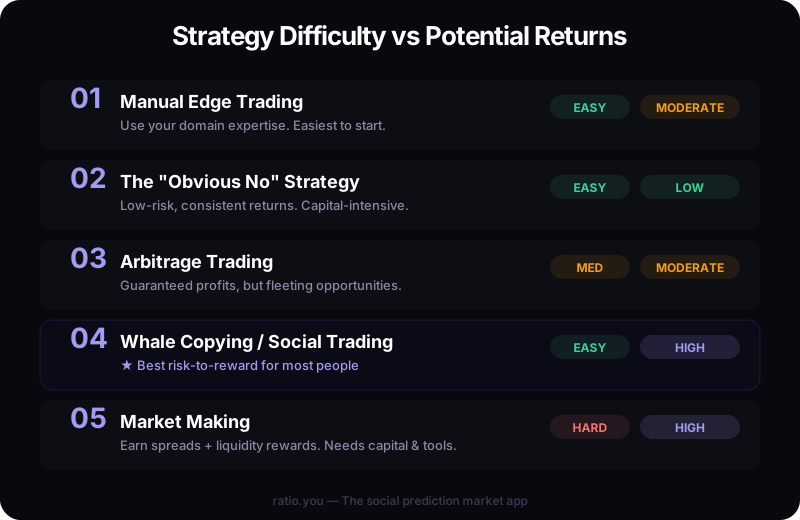
1. Manual Edge Trading
Best for: Beginners with specific knowledge areas
This is the most accessible strategy. You find markets where you genuinely know more than the crowd, and you bet accordingly.
Maybe you follow politics obsessively, or you work in tech and can predict product launches better than most. That domain expertise is your edge.
How it works:
- Focus on 2-3 categories you actually understand
- Do your own research before looking at the market price
- If your research says 70% and the market says 50%, that's a trade
- Size your positions small (1-5% of your bankroll per trade)
The catch: Your edge is only as good as your information. If you're just vibing, you're gambling.
2. The "Obvious No" Strategy
Best for: Patient traders who want low-risk returns
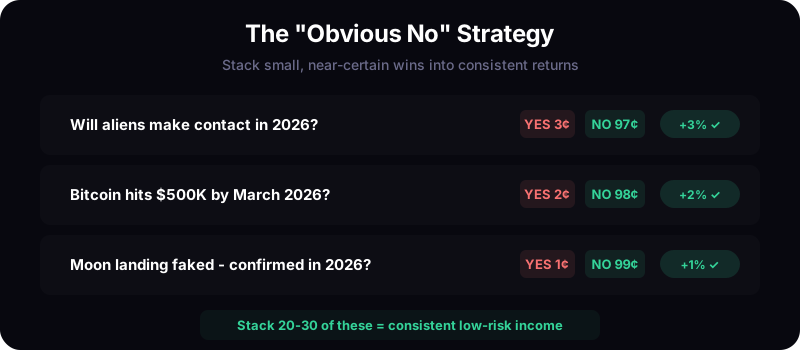
Some markets on Polymarket are priced irrationally. "Will aliens make contact in 2026?" might trade at 3-5¢ for YES. That means NO is trading at 95-97¢.
Buying NO at 97¢ gives you a 3% return when the market resolves. That's not exciting, but stack enough of these and you're printing consistent returns with very low risk.
How it works:
- Find markets where the outcome is near-certain
- Buy the near-certain side (usually NO)
- Wait for resolution and collect
- Reinvest into the next obvious market
The catch: Capital is locked until resolution. If a market takes months to settle, your annualized return might not beat a savings account.
3. Arbitrage Trading
Best for: Detail-oriented traders with some capital
Arbitrage means finding the same bet priced differently across markets. If Polymarket says an event is 60% likely and Kalshi says 50%, you can buy YES on Kalshi and NO on Polymarket, locking in a guaranteed profit.
How it works:
- Monitor the same events across Polymarket, Kalshi, and other platforms
- Calculate whether the combined cost of opposing positions is less than $1
- Execute both sides quickly before prices adjust
- Collect the spread when markets resolve
The catch: Opportunities are fleeting. Bots are fast. You need tools and capital to make this worthwhile.
4. Whale Copying / Copy Trading
Best for: Everyone - especially people who don't have time for research
This is where it gets interesting. Polymarket's transparency means you can see every trade from every wallet. Find the wallets with the best track records and mirror their moves.
How it works:
- Use analytics tools to find wallets with 60%+ win rates over 4+ months
- Follow multiple wallets to diversify (the "wallet basket" approach)
- Use an app like Ratio to follow traders with one tap
- Don't just follow - understand why they might be taking a position
The catch: Top traders know they're being watched and sometimes use decoy wallets. Diversification is key.
5. Market Making
Best for: Advanced traders with significant capital
Market makers provide liquidity by placing both buy and sell orders, earning the spread between them. On Polymarket, this means posting limit orders on both YES and NO sides of a market.
How it works:
- Place a buy order at 49¢ and a sell order at 51¢
- When both fill, you pocket 2¢ per share
- Repeat across many markets
- Earn additional liquidity rewards from Polymarket
The catch: This requires capital, speed, and risk management. If a market moves sharply in one direction, you can get stuck holding the wrong side.
Which Strategy Is Right for You?
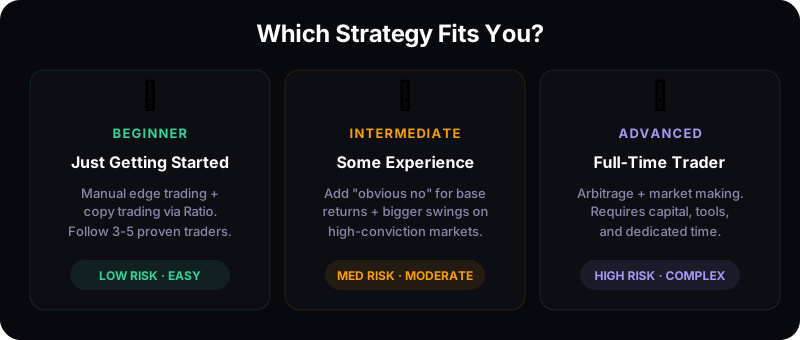
Just getting started? Go with manual edge trading in categories you know, combined with some copy trading via Ratio. Follow 3-5 proven traders and learn from their moves.
Have some experience? Layer in the "obvious no" strategy to generate consistent base returns while you take bigger swings on markets you have conviction in.
Want to go full-time? Arbitrage and market making can be very profitable but require more capital, tools, and time.
The beauty of Polymarket is that you can mix and match. Most successful traders use some combination of all five strategies, weighted toward their strengths.
Start Trading Smarter
The best strategy is the one you actually execute consistently. Don't try to be a market-making whale on day one. Start simple, track your results, and scale what works.
Download Ratio to start exploring top traders and their strategies on Polymarket.
Get Started
Ready to start copy trading?
Download Ratio and follow the best traders on Polymarket. Available on iOS and Android.