
Why Community Trading Apps Are Crushing Solo Traders on Government Shutdown Markets
Why Community Trading Apps Are Crushing Solo Traders on Government Shutdown Markets
There's a government shutdown market on Polymarket right now. It's one of those markets that looks simple on the surface—will the government shut down or not?—but is actually a nightmare to trade solo.
Here's why: government shutdown dynamics depend on behind-the-scenes negotiations, procedural votes, continuing resolutions, and political brinksmanship that can flip the odds in hours. The information is scattered across C-SPAN feeds, congressional reporter Twitter threads, and legislative tracking sites. No single trader can monitor all of it.
But a community of traders can.
This is the core argument for community trading apps and social investing platforms in 2026. Not that individual traders are dumb—they're not. But that certain markets are fundamentally better traded as a group. And prediction markets, especially fast-moving political ones, are Exhibit A.
The Problem With Trading Alone
Let's walk through what happens when you try to trade the government shutdown market solo on Polymarket:
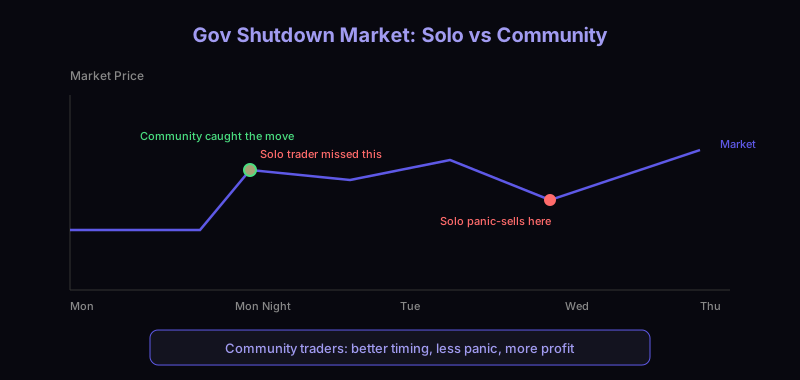
Monday morning. You read that congressional leaders are "close to a deal." The market moves to 25% chance of shutdown. You buy "No" shares.
Monday night. A faction of representatives announces they'll block the deal unless specific demands are met. The market jumps to 40%. You didn't see this coming because the news broke on a niche political podcast you don't follow.
Tuesday. Conflicting reports. Some say negotiations are back on track. Others say they've collapsed. You're refreshing three news sites and Twitter, trying to figure out which sources to trust. Meanwhile, the market is swinging 5-10% every few hours.
Wednesday. You panic-sell at a loss after a misleading headline.
Sound familiar? This isn't a skill problem. It's an information and attention problem. One person can't watch everything, process everything, and react to everything fast enough.
How Community Trading Changes the Equation
Now imagine the same scenario, but you're connected to a community of traders who are all watching different pieces of the puzzle:
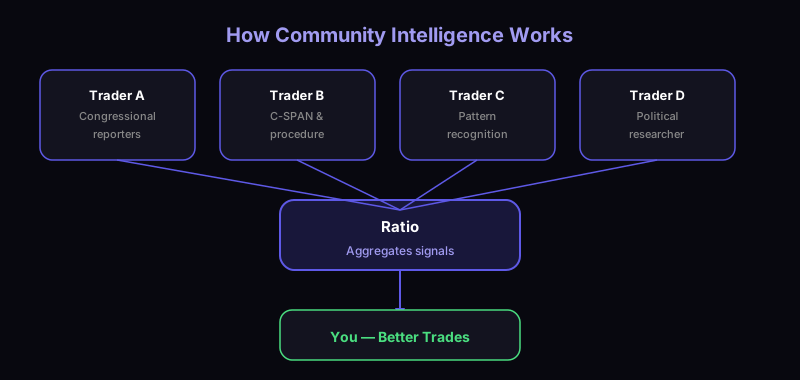
- Trader A follows congressional reporters and catches the faction revolt in real time
- Trader B monitors C-SPAN and legislative procedure, knows which procedural moves signal real risk vs theater
- Trader C has traded every shutdown market since 2023 and recognizes the negotiation patterns
- Trader D is a political science researcher who models coalition dynamics
When Trader A takes a position based on the faction news, you see it. When Trader C adjusts their position based on pattern recognition, you see that too. You're not just trading on your own analysis—you're trading on the combined intelligence of dozens of informed people.
This is what social investing platforms enable. Not groupthink. Not blindly following the crowd. But access to distributed intelligence that no individual can replicate.
The Current Landscape of Community Trading Apps
Let's look at what's actually available in 2026 for social and community trading on prediction markets:
Polymarket (Raw Platform)
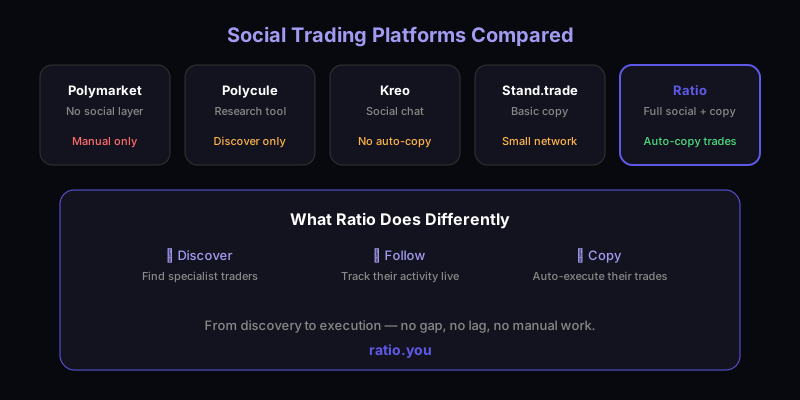
Polymarket itself has minimal social features. You can see a leaderboard of top traders, and you can manually look up individual wallets. But there's no built-in way to follow traders, get alerts on their activity, or automatically copy their positions. You're essentially a solo trader on Polymarket unless you build your own monitoring system.
Polycule
Polycule adds a social layer on top of Polymarket data. You can browse trader profiles and see performance metrics. It's better than raw Polymarket for discovery, but it's still primarily a research tool. You find interesting traders, then go back to Polymarket to manually mirror their trades. The gap between discovery and action is where edge leaks away.
Polygun
Similar to Polycule in that it provides analytics and wallet tracking. Polygun offers some alert features but the community aspect is limited. It's more of an individual analytics tool than a social platform.
Kreo
Kreo has leaned into social features—chat, discussion forums, shared analysis. The community vibe is strong. But the connection between community discussion and actual trading action is loose. People talk about trades, but executing based on that discussion still requires manual work.
Stand.trade
Stand.trade offers some copy trading functionality, which is a step in the right direction. But the platform is still early, and the trader network is small. Limited coverage means you might not find specialists for the specific market types you care about.
Ratio
Ratio takes a different approach. Instead of bolting social features onto a trading terminal, it's built from the ground up as a social trading app. The core experience is: find traders who are good at specific market types, follow them, and copy their trades automatically through the mobile app.
What makes this work for markets like the government shutdown is the combination of trader specialization and automatic execution. You follow traders who have proven track records on US political markets. When they trade the shutdown market, your position updates automatically. No refreshing news sites. No panic-selling on misleading headlines.
Why Government Shutdown Markets Are the Perfect Test Case
Government shutdown markets highlight everything that makes community trading valuable:
1. Information Is Distributed
No single source has complete information about shutdown negotiations. Congressional reporters, procedural experts, political analysts, and market makers all have different pieces. A community aggregates these naturally.
2. Speed Matters
Shutdown markets can move 10-15% in an hour when news breaks. If you're asleep, at work, or just not watching at the right moment, you miss the move. Copy trading through Ratio means someone in your network is always watching.
3. Pattern Recognition Requires Experience
Shutdown negotiations follow patterns. The "brinkmanship then last-minute deal" pattern has played out repeatedly. Experienced political traders recognize these patterns and position accordingly. Following them gives newer traders access to that experience.
4. Emotional Discipline Is Hard Solo
When the market swings wildly on conflicting reports, solo traders make emotional decisions. Community context helps: seeing that the traders you follow are holding steady (or adjusting positions thoughtfully) is a powerful anchor against panic.
How to Build Your Community Trading Strategy
Whether you're using Ratio or building a manual network, here's how to approach community trading on prediction markets:
Find Traders by Specialization
Don't follow traders with the highest overall returns. Follow traders who are specifically good at the market types you want to trade. For government shutdown markets, that means traders with strong track records on US political events.
On Ratio, you can filter traders by their performance in specific categories. On other platforms, you'll need to manually review wallet histories and figure out their specializations yourself.
Diversify Your Network
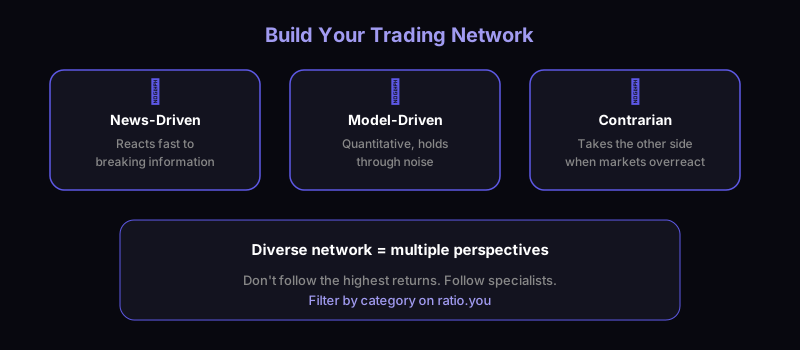
Follow traders with different approaches:
- News-driven traders who react quickly to breaking information
- Model-driven traders who use quantitative approaches and hold through noise
- Contrarian traders who take the other side when markets overreact
A diverse network means you're getting signal from multiple perspectives, not just one trading style.
Set Your Own Risk Parameters
Community trading doesn't mean blindly copying every trade. Most copy trading apps, including Ratio, let you set position sizes, maximum exposure, and other risk parameters. Use them. The point is to leverage community intelligence for better decisions, not to abdicate your own judgment entirely.
Contribute Back
The best trading communities are bidirectional. If you have expertise in a specific area—maybe you follow Congressional procedure closely, or you have contacts in political media—share your insights. On social investing platforms, your contribution makes the whole network stronger.
The Data: Does Community Trading Actually Work?
Let's look at this honestly. Community and copy trading have clear advantages in theory, but does the data back it up?
In traditional finance: eToro's copy trading data shows that copy traders who follow multiple signal providers tend to have lower drawdowns and more consistent returns than solo traders, though top-performing solo traders can outperform.
In prediction markets specifically: The data is newer, but early results from platforms with copy trading features show that traders who follow at least 3-5 specialist traders on political markets have better risk-adjusted returns than solo traders on the same markets. The advantage is strongest on fast-moving, information-heavy markets—exactly like government shutdown events.
The caveat: Copy trading doesn't guarantee profits. If you follow bad traders, you'll lose money faster. Platform quality matters because better platforms surface better traders. This is where Ratio differentiates—the social layer and performance tracking help you identify genuinely skilled traders, not just lucky ones.
Beyond Shutdowns: Where Community Trading Shines
Government shutdown markets are just one example. Community trading apps add the most value on:
- Geopolitical events (Iran, Strait of Hormuz, international conflicts) where information is scattered across languages and time zones
- Election markets where local knowledge matters
- Breaking news events where speed of information processing is everything
- Multi-leg trades (parlays) where combining insights across multiple markets creates unique opportunities
The common thread: markets where no single person can have complete information or perfect timing. That's most prediction markets, honestly.
Getting Started With Community Trading
If you've been trading prediction markets solo and hitting the wall, here's how to transition:
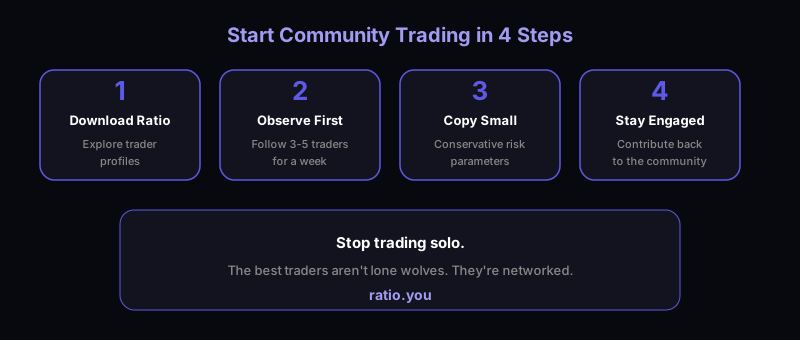
- Download Ratio and explore the trader profiles. Look at who's been profitable on the market types you trade.
- Start by observing. Follow 3-5 traders and watch their activity for a week before copying. Understand their style.
- Copy with small positions. Set conservative risk parameters. Let the system prove itself before scaling up.
- Stay engaged. The best community traders are active participants, not passive followers. Read the analysis, understand the reasoning, and build your own expertise alongside the community.
The government shutdown market will resolve one way or another. But the lesson it teaches about the limits of solo trading and the power of community intelligence? That applies to every prediction market you'll ever trade.
The question isn't whether community trading works. It's whether you want to keep going it alone.
Stop trading solo. Ratio connects you with the best prediction market traders and lets you copy their moves automatically. Join the community that trades smarter together.
Get Started
Ready to start copy trading?
Download Ratio and follow the best traders on Polymarket. Available on iOS and Android.