
What Happens When Everyone Copy Trades the Same Polymarket Whale?
The game theory of Polymarket copy trading - why crowded wallets deliver worse returns, how price impact destroys your edge, and what smart copy traders do differently.
What Happens When Everyone Copy Trades the Same Polymarket Whale?
There's a wallet that's been crushing it on Polymarket. Let's call them Whale-0x7A. They've got a 70% win rate over three months, they trade big markets like the Iran regime change predictions (currently around 39%) and 2028 election odds, and someone posted their address on Twitter.
Now 500 people are watching. 200 are actively trying to copy trade Polymarket positions every time Whale-0x7A makes a move.
Here's the question nobody asks: what happens to YOUR returns when 199 other people are doing the exact same thing?
The answer involves game theory, market microstructure, and some uncomfortable math. Let's get into it.
The Crowding Problem, Explained Simply
Polymarket is a prediction market, not a stock market. When you buy YES shares, you're buying from someone selling YES shares (or buying NO). The price moves based on supply and demand - and every buy pushes the price up a little.
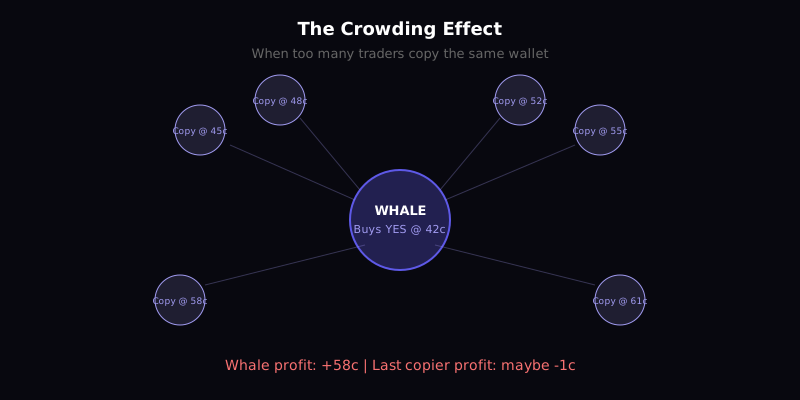
When Whale-0x7A buys YES at 42 cents, the first copy trader might get in at 45 cents. The second wave gets 48-52 cents. By the time the tweet goes viral and the third wave hits, you're buying at 58-65 cents.
The whale risked money at 42 cents. You risked money at 58 cents. Same thesis, completely different risk-reward profile.
If the market resolves YES at 100 cents, the whale made 58 cents per share. You made 42 cents. That's a 28% lower return on the exact same correct prediction - just because of crowding.
And that's the good scenario. If the market resolves NO, the whale lost 42 cents per share. You lost 58 cents. The crowding made your downside WORSE too.
The Game Theory: Your Returns Depend on Everyone Else
This is where it gets interesting. Copy trading isn't just you and the whale - it's a multiplayer game where your outcome depends heavily on what other copy traders do.
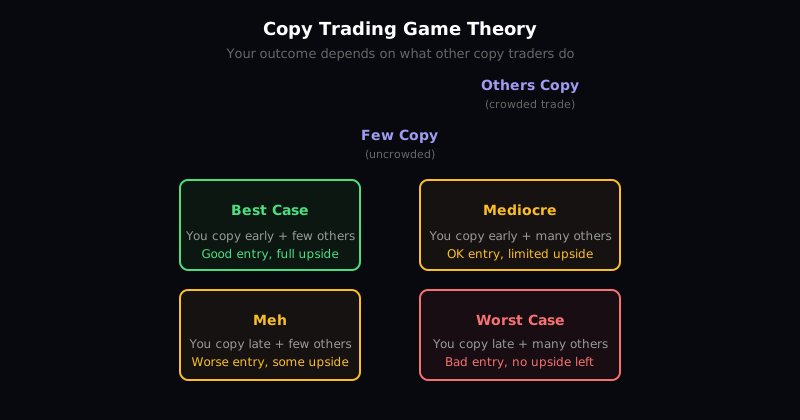
Think of it like a restaurant. A hidden gem with amazing food is great when you know about it and there's no wait. But once it gets a Michelin star and everyone shows up, the experience degrades - long waits, rushed service, maybe they even raise prices.
The "Michelin star" in copy trading is when a wallet goes viral. The moment a wallet becomes widely known as one of the best polymarket wallets to copy, its value to copy traders starts declining.
This creates a paradox: the more proven a wallet's track record, the more people copy it, the less profitable copying it becomes. The very evidence that makes a wallet worth copying is what eventually destroys the edge.
Price Impact: The Silent Return Killer
Let's put real numbers on this. Take a market like "Will the Iranian regime fall by June 30?" - currently trading around 39% with $8M in volume. That's a liquid market. Now imagine a less liquid market - say something with $200K in volume.
In the liquid market, a whale buying $50K of YES shares might move the price 1-2 cents. The copy trading wave behind them might push it another 3-5 cents. Annoying but manageable.
In the thin market? That same whale buying $50K could move the price 5-8 cents. The copy wave pushes it another 10-15 cents. You're now buying at a price that already reflects most of the upside.
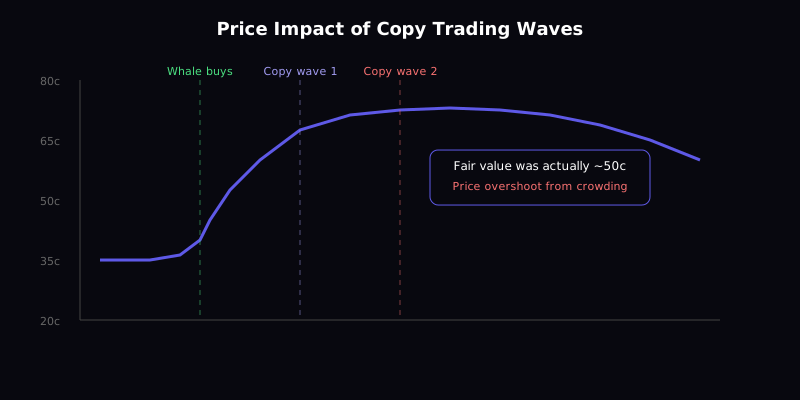
This is why your polymarket copy trading strategy needs to account for market liquidity. Copying a whale into a deep, liquid market is fundamentally different from copying them into a thin one. The thin market might actually have MORE alpha in the whale's thesis - but the crowding effect eats it all before you get there.
How Whales Respond to Being Copied
Here's the part nobody talks about: whales aren't dumb. When they realize hundreds of people are watching their wallet and copying every move, they adapt.
Some whales actually benefit from copiers. If they buy early and copy traders push the price up afterward, the whale's existing position increases in value. Some whales have been known to exploit this intentionally - buy a position, wait for the copy wave to push the price up, then sell into the inflated demand. You're not copying the whale. You're their exit liquidity.
Other whales get annoyed and start splitting their activity across multiple wallets. They'll make their "real" trades from wallets nobody knows about and keep small positions in their public wallet. If you're only tracking the famous address, you're seeing a curated subset of their actual strategy.
Smart whales also adjust their timing. Instead of placing one big order, they'll scale into positions slowly over hours or days. This makes it much harder for copy traders to catch the initial entry. By the time the position is visible on-chain, the price has already moved.
The Nash Equilibrium of Copy Trading
In game theory, a Nash equilibrium is a state where no player can improve their outcome by changing strategy alone. What's the Nash equilibrium of Polymarket copy trading?
It's roughly this: copy trading remains profitable only as long as most people DON'T do it for any given wallet. The moment a wallet gets crowded enough that entry prices consistently overshoot fair value, the rational move is to stop copying that wallet and find a less crowded one.
The market naturally self-corrects, but slowly and painfully. People keep piling into famous wallets, getting mediocre returns, and eventually giving up. Meanwhile, the traders who quietly find lesser-known profitable wallets keep their edge.
This is why the best polymarket wallets to copy aren't the ones everyone's talking about. They're the ones that are profitable AND relatively unknown.
Five Strategies Smart Copy Traders Use to Avoid Crowding
1. Go Deeper on Wallet Discovery
Instead of following the same five wallets from Twitter, use tools like ratio.you to discover wallets with strong track records that haven't gone viral yet. The discovery advantage is real - being one of 20 people copying a wallet instead of one of 500 makes an enormous difference in your entry prices.
2. Copy the Strategy, Not the Trade
Instead of trying to copy the exact position at the exact same time, study what TYPES of markets a successful wallet focuses on. Do they specialize in political markets? Crypto prices? Geopolitical events? Understanding their strategy is more valuable than chasing their individual trades.
If a whale consistently does well in election markets, you can develop similar analysis skills and potentially find the same opportunities independently - without the crowding penalty.
3. Use Time Delays Strategically
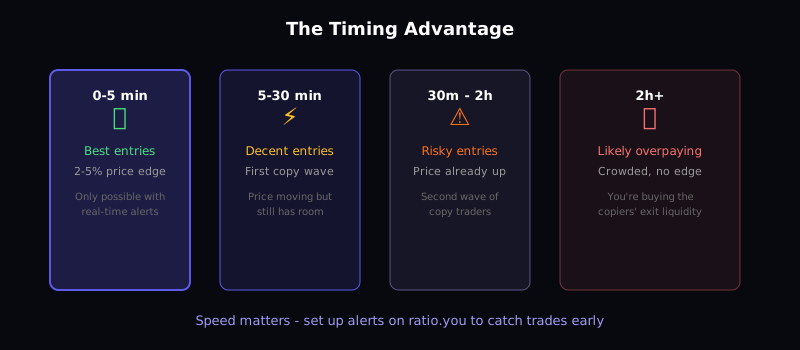
This sounds counterintuitive, but sometimes waiting is better than rushing. After the initial copy wave, prices often overshoot and then settle back. If you wait for the price to stabilize (usually 2-4 hours after a whale's trade becomes public), you can sometimes get a better entry than the first wave of panicked copiers.
The key is distinguishing between the copy wave price impact (temporary) and genuine information (permanent). If the price stays elevated after 24 hours, the market probably agrees with the whale's thesis. If it retraces, the initial move was mostly just copy trading pressure.
4. Monitor Crowding Indicators
Before copying any trade, check a few things:
- How many addresses entered the same side within an hour of the whale? (More = more crowding)
- How much did the price move from the whale's entry to current? (Bigger move = more of the edge is gone)
- What's the volume relative to open interest? (Sudden volume spikes suggest copy waves)
On ratio.you, you can track these wallet movements in real time - helping you gauge whether a trade is still worth entering or if the crowd already ate the alpha.
5. Diversify Across Uncorrelated Wallets
Don't just follow five wallets that all trade the same markets. If all your copied wallets are in political markets, one surprise event can tank all your positions simultaneously. Seek wallets that specialize in different categories - one in crypto markets, one in geopolitics, one in sports. This way, crowding in one space doesn't destroy your entire portfolio.
The Contrarian Play: Fade the Copy Wave
Here's an advanced strategy that flips the crowding problem on its head. If you know a whale's trade is going to attract a massive copy wave, you can:
- Wait for the copy wave to push the price well above fair value
- Take the OTHER side of the market (selling into the hype)
- Profit when the price corrects back toward fair value
This is risky and requires good judgment about fair value. But it highlights an important point: in the game theory of copy trading, there's always an opportunity for someone willing to think differently than the crowd.
What This Means for Your Polymarket Copy Trading Strategy
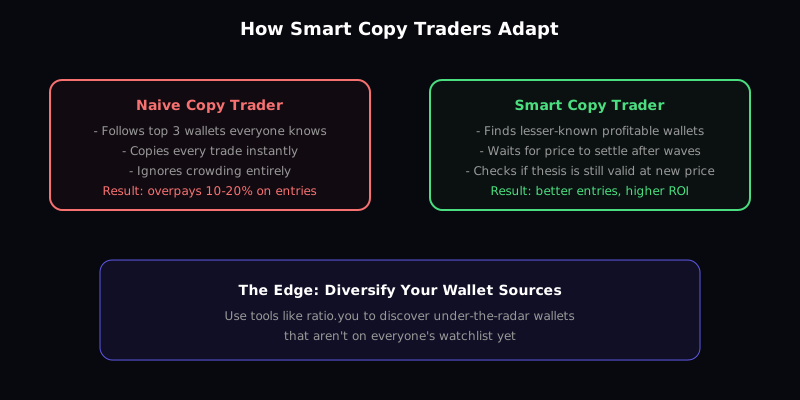
The takeaway isn't that copy trading doesn't work. It does - when done thoughtfully. But the naive version of copy trading (follow famous wallets, copy every trade instantly) has diminishing returns as more people do it.
The edge in 2026 belongs to copy traders who:
- Find wallets before they go viral using discovery tools like ratio.you
- Understand market microstructure and don't overpay for crowded entries
- Think in terms of game theory rather than just following signals blindly
- Diversify across wallets and market types to reduce correlation
- Copy strategies and thinking patterns, not just individual trades
The best copy traders aren't just following. They're thinking about who else is following, what that does to prices, and how to position themselves accordingly.
That's not just copy trading. That's actual trading.
Final Thought
Every time you're about to copy a trade, ask yourself: "How many other people are about to do the exact same thing?" If the answer is "probably hundreds," your expected return just dropped significantly.
The wallets worth copying are the ones nobody else has found yet. Start looking.
Get Started
Ready to start copy trading?
Download Ratio and follow the best traders on Polymarket. Available on iOS and Android.