
7 Polymarket Copy Trading Mistakes That Are Quietly Draining Your Bankroll
Avoid the most common copy trading mistakes on Polymarket that silently eat into your profits. Learn how to fix your polymarket copy trading strategy and stop bleeding money on bad wallet picks.
You Are Probably Making At Least Three of These
Copy trading on Polymarket sounds simple in theory. Find a profitable wallet, copy what they do, collect profits. In practice, most people who try to copy trade Polymarket end up worse off than if they had just traded on their own instincts.
The problem is rarely the concept itself. Copy trading works. The problem is a set of specific, fixable mistakes that quietly drain your bankroll while you think everything is going fine. I have seen these patterns across thousands of wallets, and once you know what to look for, they are easy to avoid.
Mistake #1: Copying Wallets Based on Total Profit Alone
This is the single most common error in any polymarket copy trading strategy. You open up wallet analytics, sort by total profit, see someone sitting on $400k in gains, and think "that is my person."
But total profit tells you almost nothing useful for copy trading purposes.
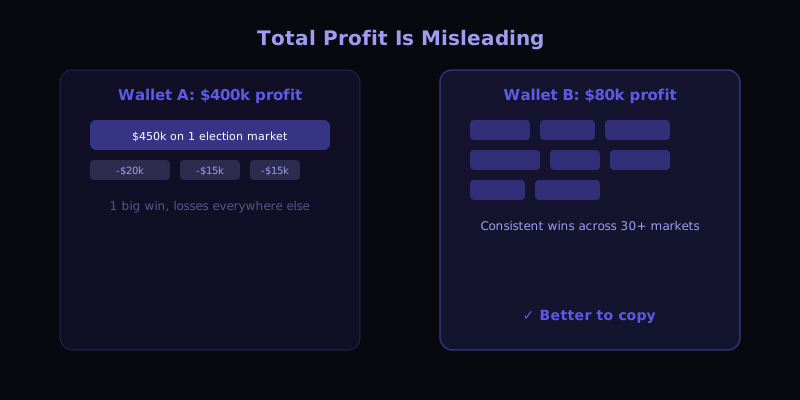
That $400k wallet might have:
- Made $450k on a single election market and lost $50k on everything else
- Been active for two years with a mediocre hit rate that just had one lucky break
- Used position sizes so large that copying them at your bankroll size is impossible
- Stopped trading three months ago (you are copying a ghost)
What you should filter for instead:
- Win rate across 20+ markets - Consistency beats one big hit
- Profit factor - Total gains divided by total losses, you want 1.5x or higher
- Recency - Are they actively trading right now?
- Diverse market participation - Profit across categories, not just one lucky sector
Ratio lets you filter wallets by all of these metrics, which is why it has become the go-to tool for serious Polymarket copy traders.
Mistake #2: Ignoring Entry Timing Completely
Even if you find the best polymarket wallets to copy, copying their positions hours or days after they enter will destroy your returns.
Here is why: when a skilled wallet buys YES on a market at 35 cents, they have identified a mispricing. By the time you see the trade and copy it, the market might already be at 45 cents. You are buying at a worse price, which means your risk/reward is fundamentally different from theirs.
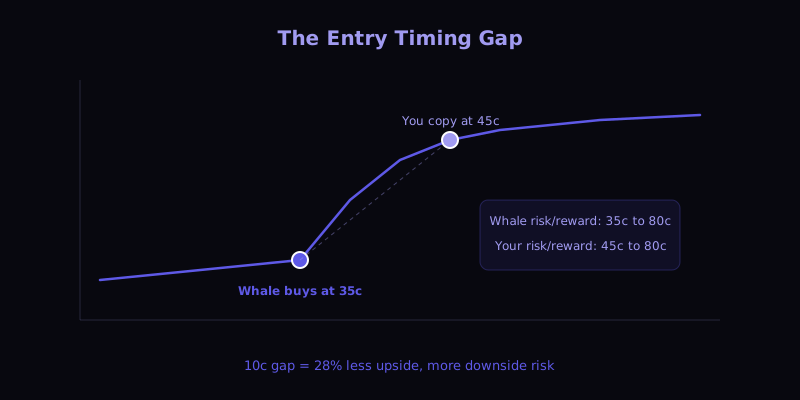
The fix is threefold:
- Monitor in real-time - Use tools that alert you to wallet activity as it happens, not hours later
- Evaluate the remaining edge - If a wallet bought at 35c and the market is now 50c, ask yourself: is there still edge at 50c? If the wallet's thesis implies 80c fair value, you still have room
- Set maximum entry delay - Give yourself a rule like "I will only copy trades within 2 hours of the wallet's entry" and stick to it
This single adjustment to your copy trade Polymarket approach can be the difference between profitable and unprofitable copy trading.
Mistake #3: Over-Concentrating in One Market Category
March 2026 has some incredibly tempting markets. The Iran situation is creating juicy mispricings in geopolitical markets. Champions League is driving massive volume in sports. Crude oil is swinging like crazy.
It is tempting to find a whale wallet crushing it in one of these categories and go all-in copying their trades. But concentrating your copy trading in a single category is a recipe for a blowup.
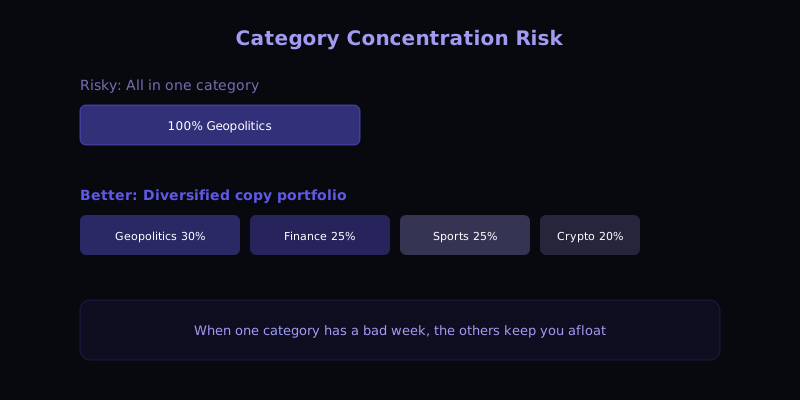
Why this kills your polymarket copy trading strategy:
- Correlated risk - All positions in one category tend to move together during shocks
- Specialist decline - Even the best category traders go through cold streaks
- Market closure bunching - When multiple markets in the same category resolve at once, you either win big or lose big with no middle ground
The better approach: build a portfolio of wallets to copy across 3-4 categories. Right now, that might look like:
- 2 geopolitics specialists (for Iran, tariffs, and global elections markets)
- 2 finance/commodities traders (for oil, Fed, and equities markets)
- 1-2 sports analytics wallets (for Champions League and other high-volume sports)
Ratio makes building this kind of diversified copy portfolio simple by categorizing wallet performance automatically.
Mistake #4: Copying Position Sizes Instead of Percentages
A whale wallet drops $50,000 on a single Polymarket position. You have $2,000 in your account. You put in $50 to "match" the trade. Sounds reasonable, right?
Wrong. You are copying the dollar amount (scaled down) but ignoring what that $50k means to the whale.
If that whale has a $2M bankroll, $50k is a 2.5% position. If you are putting $50 of your $2,000, that is also 2.5%, so you are actually fine in this case. But most people do not do this math.
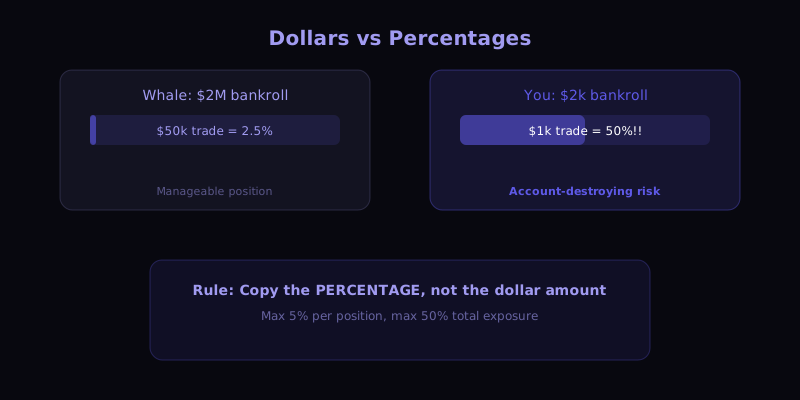
The real problem shows up when:
- You do not know the whale's total bankroll (so you cannot calculate their percentage)
- The whale is making multiple positions you are copying, and combined they represent 40%+ of your bankroll
- Different whales in your copy list all enter the same market, and you copy all of them
Rule of thumb for your copy trade Polymarket strategy: never let a single copied position exceed 5% of your bankroll, and never let total copied exposure exceed 50%.
Mistake #5: Not Accounting for the "Why" Behind Trades
This one separates beginners from advanced copy traders. When the best polymarket wallets to copy enter a position, there is usually a specific thesis behind it. If you do not understand that thesis, you cannot manage the trade properly.
Example: A whale wallet buys YES on "Crude Oil hits $110 by end of March" at 40 cents. Their thesis might be based on specific intelligence about Iran sanctions tightening supply. If sanctions news breaks differently than expected, the whale will exit quickly.
But if you copied without understanding the thesis, you might hold through negative developments because you do not recognize the thesis is broken.
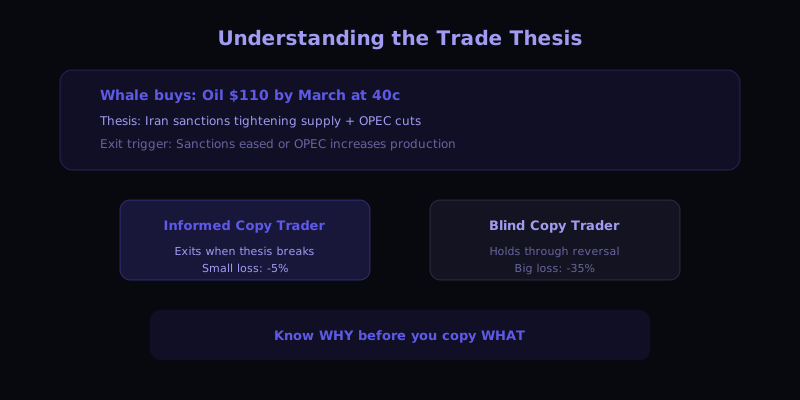
How to get better at this:
- Study the market context before copying, not after
- Watch what other smart wallets are doing in related markets for clues about the thesis
- Define your own exit criteria for every copied position
- Use Ratio to see broader wallet activity patterns that hint at the underlying thesis
Mistake #6: Abandoning Your Strategy After a Losing Streak
Every polymarket copy trading strategy will have losing periods. Even the most profitable wallets on the platform have stretches where they lose 5-10 trades in a row. This is mathematically guaranteed.
The mistake is abandoning your approach during these inevitable downswings:
- Dropping a profitable wallet from your copy list after 3 losses
- Switching to a completely different set of wallets every week
- Reducing position sizes to the point where winners do not matter
- Adding random new wallets in desperation without proper research
The best copy traders on Polymarket treat their wallet selection like a portfolio. You rebalance periodically based on data, not emotion. A monthly review of your copied wallets' performance is plenty. Anything more frequent and you are just reacting to noise.
Mistake #7: Treating Copy Trading as Passive Income
This is the biggest mindset mistake of all. Copy trading Polymarket is not passive. It is semi-active. You need to:
- Review your wallet list regularly (monthly minimum)
- Monitor position sizing and correlation across your copied portfolio
- Stay informed on the markets you are exposed to so you can recognize when theses break
- Adjust your strategy as market conditions change (what works in a calm market is different from what works now with Iran tensions and oil volatility)
The wallets you are copying are putting in hours of research. You do not need to match their research effort, but you do need to put in enough effort to copy them intelligently.
The Quick Fix Checklist
If you are currently copy trading on Polymarket and not seeing the results you expected, run through this checklist:
- Are you filtering wallets by consistency metrics, not just total profit?
- Are you copying within a reasonable time window of the original trade?
- Is your copy portfolio diversified across at least 3 market categories?
- Are you sizing positions as percentages, not arbitrary dollar amounts?
- Do you understand the basic thesis behind each position you are copying?
- Have you maintained your strategy through at least one losing streak without panic-changing?
- Are you spending 30+ minutes per week actively managing your copy trading approach?
If you answered "no" to more than two of these, that is where your leaks are.
Head to Ratio to start building a more disciplined copy trading portfolio. Filter wallets by the metrics that actually matter, track their activity in real-time, and stop making the mistakes that silently eat into your profits.
The difference between copy trading that works and copy trading that does not is not luck. It is process. Fix the process, and the results follow.
Get Started
Ready to start copy trading?
Download Ratio and follow the best traders on Polymarket. Available on iOS and Android.