
5 Mistakes Every New Polymarket Trader Makes (And How to Avoid Them)
New to prediction markets? Avoid these costly beginner mistakes that drain most Polymarket accounts in the first month.
The Expensive Learning Curve
Most new Polymarket traders lose money in their first month. Not because prediction markets are rigged - but because they make the same avoidable mistakes everyone makes.
Here are the five biggest ones, and how to dodge them.
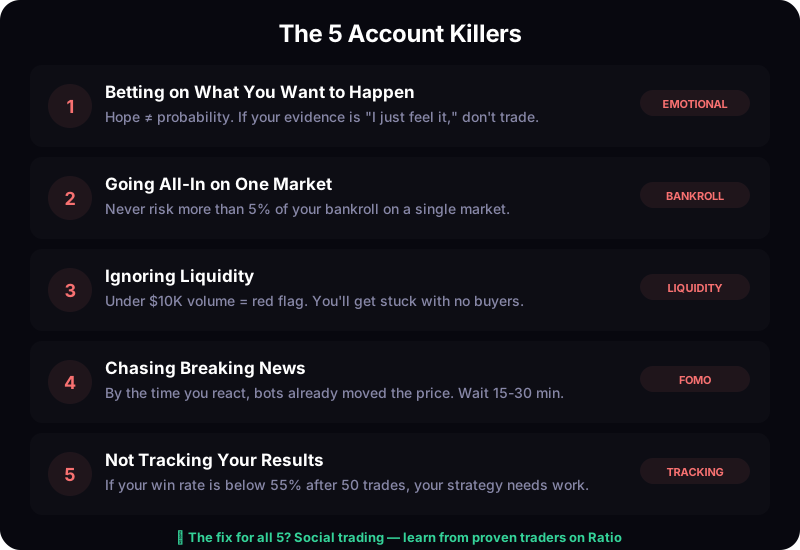
Mistake #1: Betting on What You Want to Happen
This is the number one killer. You believe a candidate should win, so you buy YES. You think a product should launch, so you bet on it. Your conviction comes from hope, not analysis.
Prediction markets are not opinion polls. They're financial instruments. The market doesn't care what you want to happen - it cares about probability.
How to avoid it:
- Before entering a trade, write down your probability estimate and the evidence supporting it
- If your only evidence is "I just feel like it'll happen," don't trade
- Actively seek out information that contradicts your position
- Ask yourself: "Would I take this same position if I had no emotional stake?"
Mistake #2: Going All-In on One Market
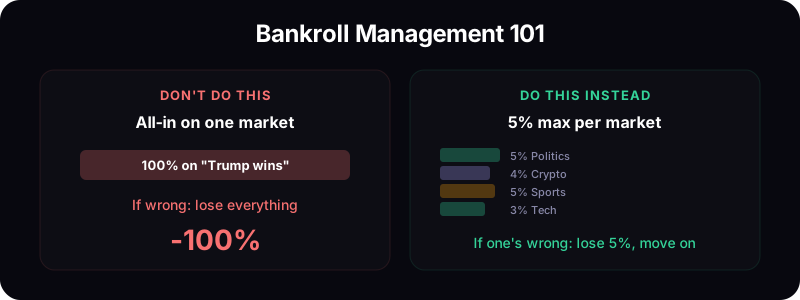
New traders find a market they're confident about and dump their entire bankroll into it. Even if they're right 70% of the time, the 30% wipeout erases everything.
This is basic bankroll management, and most people skip it entirely.
How to avoid it:
- Never put more than 5% of your total bankroll on a single market
- Spread your capital across at least 10-15 different positions
- Think in terms of expected value, not individual outcomes
- If losing a bet would significantly impact your finances, you've bet too much
Mistake #3: Ignoring Liquidity
You spot a market where you think YES is underpriced at 30¢. You buy in. But the market has almost no volume - maybe $500 total. Now you own a position that nobody else is trading.
When you try to sell, there's nobody to sell to. You're stuck waiting for the market to resolve, or selling at a massive discount.
How to avoid it:
- Check the market's total volume before entering. Under $10K is a red flag for anything more than a tiny position
- Look at the order book depth - can you exit your position without moving the price significantly?
- Stick to markets with $100K+ volume for serious positions
- Remember: low liquidity is how smart traders create exit liquidity for themselves
Mistake #4: Chasing Breaking News
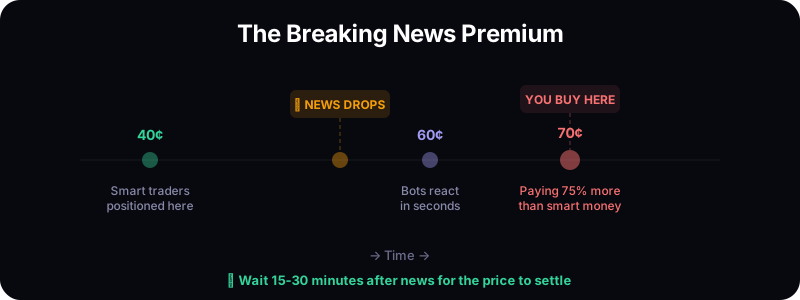
A headline drops. You rush to Polymarket to bet on it. But by the time you open the app, bots and professional traders have already moved the price. You're buying at the new price, not the old one.
This is the "breaking news premium." The market already priced in the news before you could react. When you buy at 70¢ after news already moved it from 40¢, you're paying for stale information.
How to avoid it:
- If a price just spiked on news, don't FOMO in
- Wait for the market to settle (usually 15-30 minutes after a major event)
- Focus on slow-moving information advantages, not breaking news
- Copy trading through Ratio helps here - good traders position before news drops, not after
Mistake #5: Not Tracking Your Results
Most new traders have no idea what their actual win rate is. They remember their wins vividly and forget their losses. This selective memory prevents you from learning and adjusting.
Without tracking, you can't tell if your strategy is actually working or if you've just been lucky.
How to avoid it:
- Keep a simple spreadsheet: market, position, entry price, exit/resolution price, profit/loss
- Review weekly - what went right, what went wrong?
- Calculate your actual win rate and ROI
- If your win rate is below 55% after 50+ trades, your strategy needs work
- Use Ratio to track top traders' results and learn from their patterns
The Meta-Mistake: Trading Alone
The biggest mistake that encompasses all of the above? Trying to figure everything out by yourself.
Prediction markets have a massive information asymmetry. Some traders have specialized tools, faster data feeds, domain expertise, and years of experience. Going solo against these advantages is playing on hard mode.
The alternative: social trading. Instead of guessing alone, follow traders who have already solved these problems. Learn from their positions, understand their reasoning, and build your own edge over time.
Ratio exists specifically for this. It turns prediction market trading from a solo activity into a social one - and that's the fastest way to stop making expensive beginner mistakes.
Download Ratio and learn from the best traders on Polymarket.
Get Started
Ready to start copy trading?
Download Ratio and follow the best traders on Polymarket. Available on iOS and Android.