
Polymarket's Strait of Hormuz Markets Explained: How Traders Are Betting on the Iran Crisis
A complete guide to Polymarket's Strait of Hormuz and Iran markets in March 2026. Understand the geopolitical context, how these markets work, and how prediction market traders are positioning themselves.
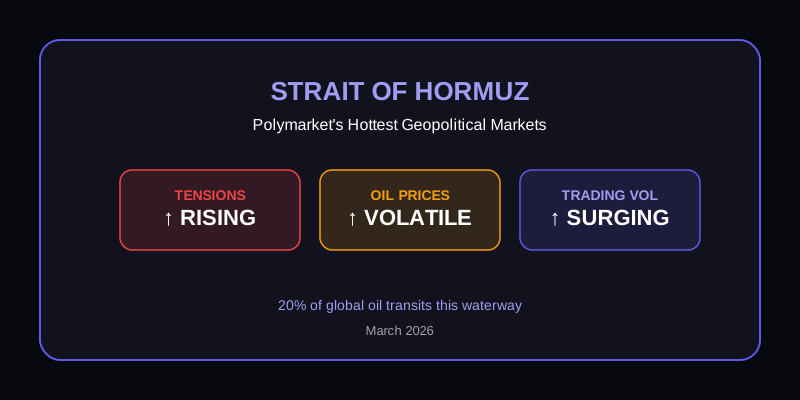
The Strait of Hormuz Is Polymarket's Hottest Market Right Now
If you've logged into Polymarket recently, you've probably noticed Iran and the Strait of Hormuz dominating the trending section. And for good reason: roughly 20% of the world's oil passes through that narrow waterway, and tensions between Iran and the US have been escalating steadily through early 2026.
Prediction markets thrive on uncertainty, and right now the Strait of Hormuz situation has uncertainty in spades. Military posturing, diplomatic back-channels, oil price volatility, shipping insurance rates spiking... it's the kind of multi-layered geopolitical situation that generates dozens of tradeable markets.
Let's break down what's actually happening, how these markets work, and how traders are positioning themselves.
What's Going On With the Strait of Hormuz?
For context, the Strait of Hormuz is a narrow passage between Iran and Oman connecting the Persian Gulf to the open ocean. Nearly all oil exports from Saudi Arabia, Iraq, Kuwait, and the UAE pass through it. Iran has threatened to close or disrupt the strait multiple times over the decades, but has never fully followed through.
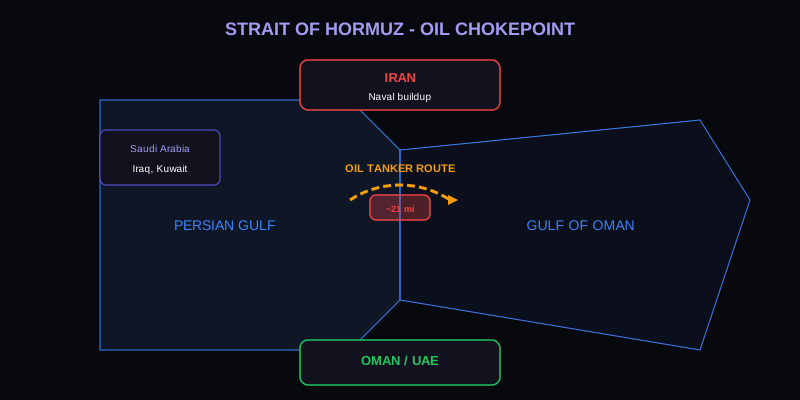
In early 2026, a combination of factors has pushed tensions to their highest point in years:
- Renewed sanctions pressure on Iran's oil exports
- Naval buildups in the Persian Gulf from both the US and Iran
- Proxy conflicts in the region creating additional friction points
- Iran's domestic politics pushing leadership toward more confrontational stances
This isn't just theoretical. Shipping insurance rates for vessels transiting the strait have jumped significantly, and several companies have started routing around the Cape of Good Hope as a precaution. When the real-world economy starts pricing in risk, prediction market traders pay attention.
How Polymarket's Iran and Strait of Hormuz Markets Work
Polymarket has spun up multiple markets related to the situation. Here's how the main categories break down.
Binary Outcome Markets
The most straightforward markets are simple yes/no questions:
- "Will there be a military confrontation between US and Iran before July 2026?"
- "Will the Strait of Hormuz be blocked to commercial shipping in Q2 2026?"
- "Will Iran and US reach a diplomatic agreement by end of 2026?"
These work like any other Polymarket binary. You buy YES or NO shares at the current market price (between $0.01 and $0.99), and they resolve to $1.00 or $0.00 based on the outcome. The current price reflects the market's collective probability estimate.
Oil Price Markets
Connected to the geopolitical situation are oil price markets:
- "Will Brent crude exceed $100/barrel in Q2 2026?"
- "Will oil prices spike above $120/barrel at any point in 2026?"
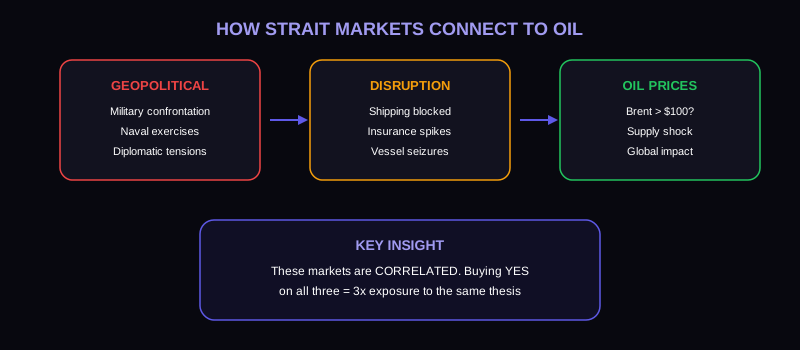
These are directly linked to the Strait of Hormuz situation because any serious disruption would immediately impact global oil supply and prices.
Timeline and Escalation Markets
Some of the most interesting markets involve escalation timelines:
- "Will Iran conduct a naval exercise in the Strait of Hormuz in March 2026?"
- "Will any commercial vessel be seized or attacked in the Strait of Hormuz in Q2 2026?"
These granular markets let traders express views on specific escalation steps rather than just the ultimate outcome.
What the Smart Money Is Saying
Right now, the market is pricing in meaningful risk but not certainty. Here are some general patterns visible in the order books:
Moderate escalation is the consensus. Most markets related to increased tensions, naval exercises, and diplomatic rhetoric are trading at elevated probabilities. The market believes things will get worse before they get better.
Full blockade is still considered unlikely. Markets on a complete closure of the Strait remain relatively low probability. The reasoning: Iran depends on the strait for its own oil exports, and a full blockade would trigger a military response that Iran likely can't sustain.
Oil price spillover is priced in. The oil markets connected to the Iran situation are trading at higher probabilities than they were a month ago, suggesting traders see even a partial disruption as enough to move crude prices significantly.
Diplomatic resolution is a longer-term bet. Markets on a deal or de-escalation agreement are priced low for near-term resolution but higher for end-of-year outcomes. The market seems to think this drags on but eventually gets resolved.
How to Trade These Markets (If You're New to Geopolitical Betting)
Geopolitical markets are different from sports or crypto markets in a few important ways.
Information Asymmetry Is Real
Unlike sports (where stats are public) or crypto (where on-chain data is visible), geopolitical events are influenced by classified intelligence, private diplomatic channels, and decisions made by a small number of people behind closed doors. This means:
- Public information gets priced in quickly
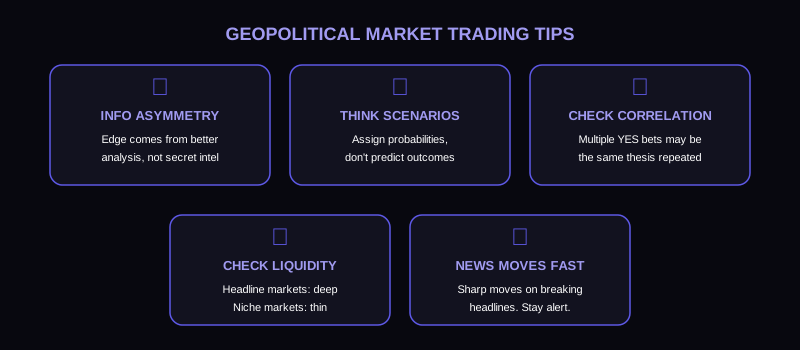
- Edge comes from better analysis of public information, not from having secret intel
- Markets can move sharply on breaking news in ways that are hard to anticipate
Think in Scenarios, Not Predictions
The best geopolitical traders don't predict what will happen. They assign probabilities to different scenarios and look for markets where the price doesn't match their probability estimate.
For example, if you think there's a 30% chance of a significant shipping disruption but the market is pricing it at 15%, that's a buy, even though you think it probably won't happen. Expected value, not confidence, drives the trade.
Watch for Correlation
Many of the Iran/Strait of Hormuz markets are correlated. If you buy YES on "military confrontation" AND YES on "oil above $100" AND YES on "shipping disruption," you're essentially making the same bet three times with different labels. Your actual exposure to the escalation thesis is 3x what each individual position suggests.
Diversification means taking positions that aren't all driven by the same outcome. Maybe you think tensions rise but a diplomatic solution is found before any actual disruption. In that case, you might buy YES on tension/rhetoric markets and YES on diplomatic resolution, creating a more nuanced position.
Liquidity Varies Wildly
The headline markets (military confrontation, oil prices) tend to have deep order books with tight spreads. But some of the more granular markets (specific naval exercises, individual diplomatic events) can be thin. Check the order book before placing a trade. If the spread is wide, you're paying a premium to enter and will pay again to exit.
Why Prediction Markets Matter for Geopolitical Events
Traditional news coverage of the Iran situation ranges from level-headed analysis to breathless fearmongering. It's hard to know how seriously to take any given headline.
Prediction markets offer something different: a real-time, money-weighted probability estimate. When traders put actual money behind their views, the signal quality improves dramatically compared to pundits giving hot takes on cable news.
That doesn't mean Polymarket is always right. Markets can be wrong, especially on tail events. But the collective intelligence of thousands of traders with skin in the game tends to produce more calibrated probability estimates than any single expert.
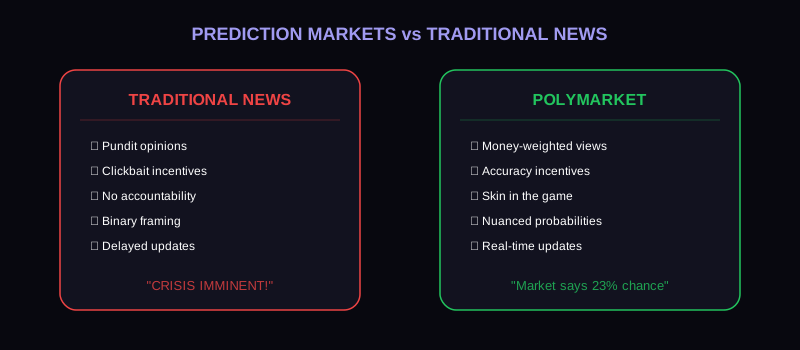
If you're someone who follows geopolitics, checking Polymarket's probability estimates for major scenarios gives you a much better sense of how the informed consensus is shifting than reading headlines.
Following Geopolitical Traders and Getting Better at This
If this kind of analysis interests you but you're not ready to start placing trades on your own, there's a middle path: watching how experienced geopolitical traders on Polymarket are positioning themselves.
Some wallets on Polymarket specialize in geopolitical markets. They tend to be more analytical, more patient, and better at scenario-based thinking than the average trader. Watching their positions evolve as the situation develops is an education in itself.
This is where Ratio becomes genuinely useful. Instead of manually tracking wallet addresses and trying to piece together their positions, Ratio lets you follow top-performing traders and see how they're positioned across related markets. For a situation like the Strait of Hormuz, where dozens of interconnected markets are all moving based on the same underlying geopolitics, seeing a sharp trader's complete position map is incredibly valuable.
The social features add another layer. When experienced geopolitical analysts in the Ratio community share their reasoning for why they're positioned a certain way, you get the context behind the trade. "I'm buying YES on shipping disruption because insurance rates just doubled" is worth a lot more than just seeing a position appear in a wallet.
Whether you're actively trading these markets or just trying to understand the situation better, combining Polymarket's real-time probabilities with community analysis from Ratio gives you a much clearer picture than traditional news sources alone.
Get Started
Ready to start copy trading?
Download Ratio and follow the best traders on Polymarket. Available on iOS and Android.