
The Psychology of Copy Trading: Why Your Brain Sabotages Your Polymarket Returns
Your biggest enemy when you copy trade Polymarket isn't bad wallets - it's your own brain. Learn the 6 cognitive biases that destroy copy trading profits and how to beat them.
The Psychology of Copy Trading: Why Your Brain Sabotages Your Polymarket Returns
You found some great wallets. You've got a solid polymarket copy trading strategy. Your watchlist is dialed in. And yet - your returns still suck.
Here's the uncomfortable truth: the problem probably isn't the wallets you're copying. It's the three pounds of gray matter between your ears making terrible decisions about when to copy, who to follow, and when to bail.
Let's talk about the six cognitive biases that quietly drain the accounts of Polymarket copy traders - and what you can actually do about them.
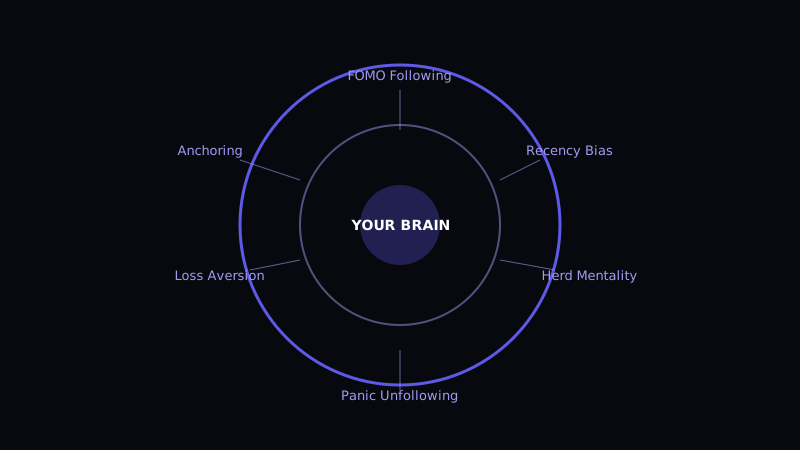
1. FOMO Following - The Most Expensive Bias in Copy Trading
You're scrolling through ratio.you and see a wallet that just crushed it - 80% win rate over the past week, nailed three big markets in a row. Your brain screams: "Follow this wallet NOW before you miss the next trade."
So you follow. You copy their next position. But here's what happened behind the scenes: that wallet's hot streak attracted hundreds of other copy traders. By the time you bought in, the price had already moved 10-15 cents from where the whale originally entered.
You're not copying the whale's trade. You're copying a worse version of it.
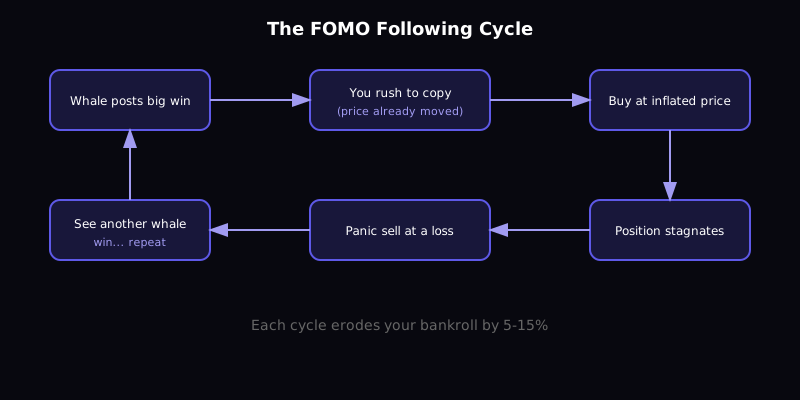
This cycle is brutal because it feels rational in the moment. The wallet IS performing well. The trade IS based on real analysis. But your entry price is fundamentally different from theirs - and in prediction markets, a few cents of edge is everything.
How to beat it
When you find a hot wallet and want to copy trade Polymarket positions immediately, force yourself to wait 24 hours. If the wallet still looks good after the initial hype dies down - and you can still get reasonable entry prices - then follow. The best polymarket wallets to copy will still be good tomorrow.
2. Recency Bias - Why You're Picking the Wrong Wallets
Your brain gives disproportionate weight to recent events. A wallet that went 8-for-8 this week feels more trustworthy than one that went 60% over six months - even though the second wallet has way more data behind it.
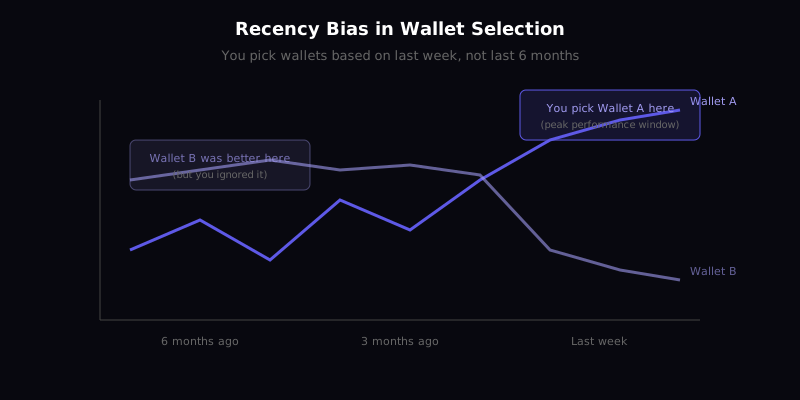
This is maybe the most common mistake in polymarket copy trading strategy. People chase hot streaks instead of looking at long-term consistency. And Polymarket makes this worse because markets resolve constantly - there's always a fresh "hot wallet" to chase.
Think about it this way. A wallet that won 8 trades in a row could easily be running at their historical average. Or they could be on a lucky streak that's about to mean-revert hard. With only 8 data points, you genuinely can't tell.
How to beat it
Never evaluate a wallet on less than 30 days of data. Ideally 90+. When you're browsing wallets on ratio.you, sort by longer timeframes first. Hot weeks are noise. Consistent quarters are signal.
3. Loss Aversion - Why You Quit Good Wallets Too Early
Daniel Kahneman's research showed that losses feel roughly twice as painful as equivalent gains feel good. This has devastating implications for copy trading.
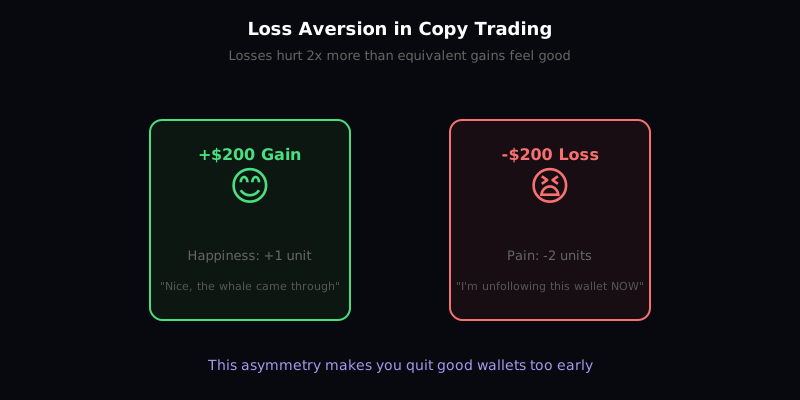
Here's what happens in practice: you follow a wallet that has a 65% win rate. That's genuinely excellent on Polymarket. But a 65% win rate means you're losing 35% of the time. After three losses in a row (which is statistically inevitable), your brain panics and tells you to unfollow.
So you unfollow. The wallet then hits a winning streak. You missed it. You go find another wallet based on recent performance (recency bias again), and the cycle continues.
The math is clear: if you're unfollowing wallets after every losing streak, you're guaranteed to buy high and sell low on your wallet selections. You're pattern-matching on noise.
How to beat it
Set an unfollow threshold BEFORE you start following a wallet. Something like: "I'll unfollow if their 60-day ROI drops below -10%" or "I'll unfollow if win rate drops below 52% over 30+ resolved markets." Write it down. Stick to it. Don't let a bad Tuesday override your system.
4. Herd Mentality - Following Wallets Because Everyone Else Does
This one's sneaky. You see a wallet mentioned in every Discord, every Twitter thread about the best polymarket wallets to copy. It must be good, right? Everyone says so.
The problem: the more people who copy trade Polymarket using the same wallet, the worse the returns get for everyone. This is pure market mechanics - when 500 people pile into the same position after a whale, the price moves against all of them.
Popular wallets aren't necessarily bad wallets. But the crowding effect means your actual returns will be significantly lower than the whale's returns. We wrote more about this crowding dynamic in our other post - but the psychology piece is important here. Your brain wants social proof. It feels safer following the wallet everyone talks about. That safety is an illusion.
How to beat it
Deliberately seek out wallets that nobody's talking about yet. The less crowded, the better your entries will be. Tools like ratio.you help you discover profitable wallets that haven't gone viral - that's where the real edge lives.
5. Anchoring - Getting Stuck on Irrelevant Numbers
You see a market trading at 72 cents. A whale you follow bought in at 45 cents. Your brain anchors to that 45-cent entry and thinks, "72 cents is too expensive."
But is it? If the fair value is actually 85 cents, then 72 cents is still a great buy. Your brain doesn't care about fair value - it's anchored to the whale's entry price, which is completely irrelevant to whether the trade is good for you right now.
This works in reverse too. A market drops from 60 cents to 40 cents. You anchor to 60 and think it's cheap. But maybe the fundamentals changed and fair value is now 30 cents.
How to beat it
Every time you copy a trade, ask: "Would I take this position at THIS price if I'd never seen the whale's entry?" If not, skip it. The whale's entry price is their edge, not yours.
6. The Disposition Effect - Holding Losers, Cutting Winners
This one comes directly from behavioral finance. Traders have a well-documented tendency to sell winning positions too early (to "lock in gains") while holding losing positions too long (hoping they'll recover).
In copy trading, this manifests as: you follow a whale into a YES position at 55 cents. It moves to 70 cents. You sell to secure your profit. The whale holds, and it resolves at 100 cents. You left 30 cents on the table.
Meanwhile, another position drops from 55 to 35 cents. You hold because "it might come back." The whale already exited at 45 cents - but you weren't watching their sells, only their buys. It resolves at zero.
How to beat it
If you're going to copy trade Polymarket, commit to copying the FULL lifecycle of a position. Enter when they enter, exit when they exit. Half-copying is worse than not copying at all because your emotional decisions will systematically underperform the wallet's actual strategy.
Track exit signals on ratio.you so you know when the wallets you follow are reducing positions - not just when they're buying.
Putting It All Together: The Anti-Bias Framework
Knowing about these biases isn't enough. You need systems that make good behavior the default.
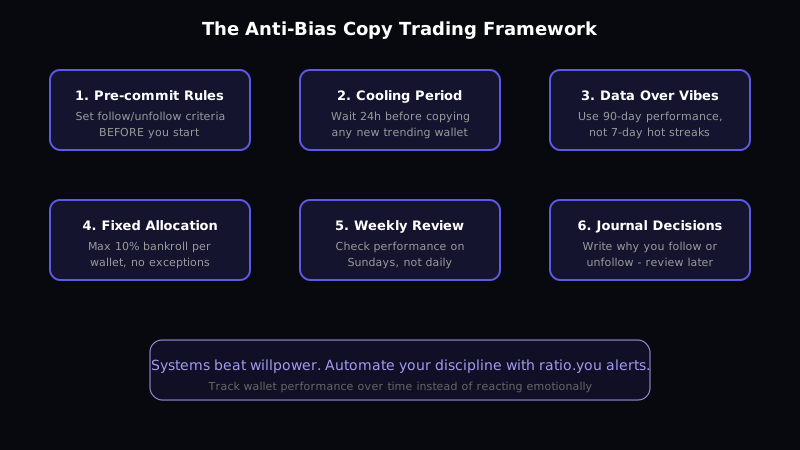
The best polymarket copy trading strategy isn't just about finding great wallets - it's about building guardrails around your own psychology. Here's the framework:
Pre-commit to rules. Before you follow any wallet, write down your entry criteria, your position sizing, and your unfollow conditions. Decide with a clear head so future-you doesn't have to decide while emotional.
Batch your decisions. Don't check wallet performance hourly. Set a weekly review on Sundays. This single change eliminates most of the emotional whiplash that causes bad decisions.
Use automation. Set up alerts on ratio.you instead of manually refreshing. Automation removes the temptation to make impulsive changes. You get notified of what matters and ignore the rest.
Track your decisions. Keep a simple log: what you followed, why, what you unfollowed, why. Review it monthly. You'll be shocked at how many decisions were driven by emotion rather than logic.
The Bottom Line
Your brain evolved to survive on the savanna, not to copy trade Polymarket rationally. Every instinct that kept your ancestors alive - following the crowd, overweighting recent threats, running from losses - will hurt your prediction market returns.
The good news: now that you know these biases exist, you can build systems around them. The traders who consistently profit from copy trading aren't the ones with the best wallets. They're the ones who've learned to override their own psychology.
Start with one bias. Build one system. The compound effect of slightly more rational decision-making is enormous over hundreds of trades.
Your brain is working against you. Build systems that work for you instead.
Get Started
Ready to start copy trading?
Download Ratio and follow the best traders on Polymarket. Available on iOS and Android.