
How To Scale Your Polymarket Copy Trading From $100 to $10K
A step-by-step copy trading scaling strategy for Polymarket. Learn how to grow a small bankroll by copying the best polymarket wallets, managing position sizes, and compounding returns without blowing up.
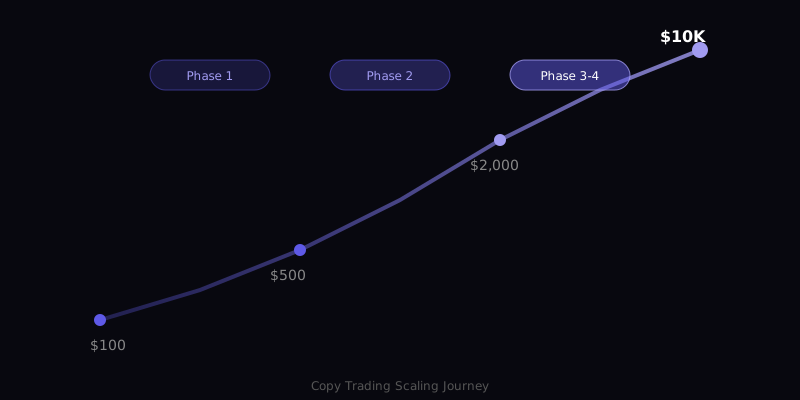
Most Copy Traders Stay Small Forever. Here's How To Actually Grow.
You deposited $100 into Polymarket. You found a few wallets to copy trade. You're making a few bucks here and there.
But six months later? You're still sitting at $130. Maybe $90 on a bad week.
The problem isn't that your polymarket copy trading strategy is bad. The problem is that scaling copy trading is a completely different skill than starting it. The wallets you copy at $100 are not the same wallets you should copy at $1,000. The position sizes that work with a tiny bankroll will destroy a larger one. And the compounding math that turns $100 into $10K requires a discipline most copy traders never develop.
Let's fix that.
Phase 1: The $100 to $500 Foundation
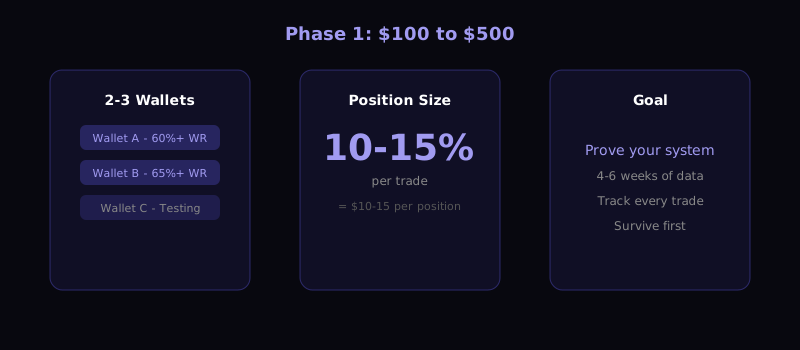
At this stage, your only job is survival. You're not trying to get rich. You're trying to prove that your copy trading system works.
Pick 2-3 Wallets Maximum
When you're working with $100, spreading across 10 wallets means $10 per position. That's meaningless. Even a 50% gain on a position nets you $5. Instead, focus on finding the 2-3 best polymarket wallets to copy that have consistent, moderate returns.
What does "consistent" look like? You want wallets on Ratio that show:
- Win rates above 60% across at least 30 trades
- Average position sizes between $500 and $5,000 (not whales, not minnows)
- Activity across multiple market categories - not just one hot topic
Mirror at Fixed Percentages, Not Fixed Dollars
Here's where beginners mess up. They see a wallet buy $2,000 worth of YES on the Iran regime market (currently at 33%) and they throw in their full $100.
Don't do that. Set a rule: each copy trade gets 10-15% of your bankroll. At $100, that's $10-15 per trade. Boring? Yes. Necessary? Absolutely.
The math works like this: if you're copying 2-3 wallets and each makes 3-5 trades per week, you have 6-15 active positions. At 10% per position, you're never more than about half deployed. That breathing room is what keeps you alive.
Track Everything
Start a simple spreadsheet. For every copy trade you make, log:
- Which wallet you copied
- The market and position
- Your entry price
- The outcome
After 4-6 weeks, you'll have enough data to know which wallets are actually performing and which are just noise.
Phase 2: $500 to $2,000 - The Diversification Jump
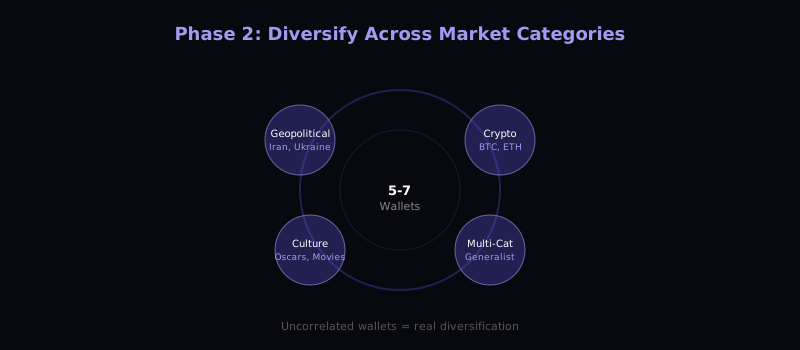
You've proven your system works. Your bankroll has grown 5x. Now the game changes.
Expand to 5-7 Wallets
With $500+, you can afford to diversify your copy trade sources. But here's the key insight most people miss when they copy trade Polymarket at this level: you want wallets that are uncorrelated.
What does that mean? If three of your wallets all bought YES on "Will the Iranian regime fall by June 30?" you don't have three independent positions. You have one massive bet. The current $11M volume on that market means plenty of wallets are in there - but copying three that all took the same side gives you zero diversification benefit.
Instead, build your wallet roster like a portfolio. Using Ratio, look for:
- One wallet that specializes in geopolitical markets (Iran, Ukraine, China tensions)
- One that focuses on crypto markets (BTC 5-minute, ETH movements)
- One that plays entertainment and culture (Oscars 2026, movie parlays)
- One or two that trade across categories
Introduce Tiered Position Sizing
Not all copy trades deserve equal weight. At this phase, assign tiers:
Tier 1 (20% of bankroll per trade): Your top-performing wallet. The one with the best track record from Phase 1.
Tier 2 (10% per trade): Solid wallets with good but shorter track records.
Tier 3 (5% per trade): New wallets you're testing. Always be auditioning new wallets to copy on Polymarket.
This tiering system means your best signals get the most capital while you're constantly developing your next top performer.
Phase 3: $2,000 to $5,000 - The Compound Effect
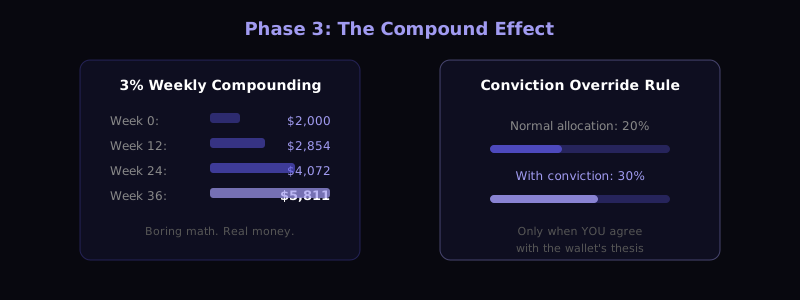
This is where most copy traders plateau. They hit a few thousand dollars and then start making emotional decisions. They chase bigger positions. They abandon their system for a "hot tip." They stop tracking.
Reinvest Profits Systematically
The secret to scaling from $2K to $5K is boring: take your weekly profits and increase your position sizes proportionally. If your bankroll grew 10% this week, next week's positions are 10% bigger.
This is where copy trading on Polymarket actually has an advantage over traditional trading. Because Polymarket positions resolve to 0 or 1, you get regular resets. A position resolves, you collect your payout, and you redeploy at your new (larger) size.
Add a "Conviction Override"
At this bankroll level, you can start adding a human layer to your copy trading strategy. When you see one of your best polymarket wallets to copy take a position and you independently agree with the thesis, you can bump that trade up by 50%.
For example, right now the "US forces enter Iran by March 31" market sits at 46%. If your top wallet goes heavy on YES and your own research supports that direction, your Tier 1 allocation of 20% becomes 30% for that specific trade.
But - and this is critical - you only do this when you've done independent analysis. Conviction override is not "this wallet is hot so I'll pile in more." That's just leveraging someone else's gambling.
Start Tracking Risk-Adjusted Returns
Raw PnL is misleading at this stage. A wallet that makes $500 by risking $5,000 is very different from one that makes $500 by risking $1,000. Use Ratio's wallet analytics to compare not just total returns but the consistency of those returns. Wallets with smoother equity curves are worth more to a scaling copy trader than volatile moonshot wallets.
Phase 4: $5,000 to $10,000 - Playing the Long Game
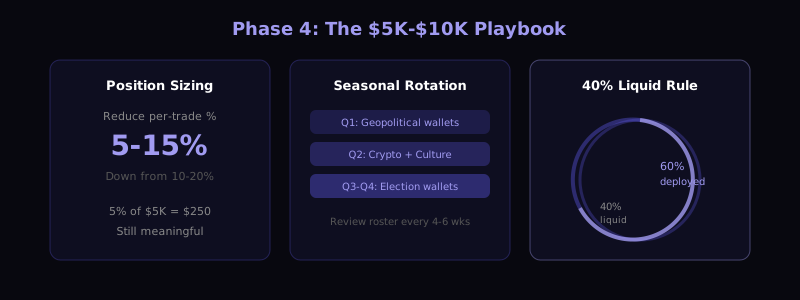
You've 50x'd from your starting point. The temptation to swing for the fences is enormous. Resist it.
Reduce Average Position Back Down
This sounds counterintuitive, but as your bankroll grows, your per-trade percentage should actually decrease slightly. At $5K+, move from 10-20% per trade down to 5-15%. You have enough capital now that 5% of your bankroll is a meaningful position, and the reduced concentration protects you from the inevitable bad streak.
Build "Copy Trading Seasons"
The best polymarket wallets to copy shift over time. A wallet that crushed it during the 2024 election cycle might be mediocre on geopolitical markets. The wallet dominating Iran markets right now might flop when those resolve and the market shifts to 2026 midterms.
Plan for this. Every 4-6 weeks, review your wallet roster on Ratio. Promote strong performers. Demote or drop weak ones. Add fresh blood.
Use Market Cycles to Your Advantage
Right now, Polymarket is seeing massive volume on Iran ($11M+), tariff impacts, and Oscars 2026. Six months from now, the hot markets will be completely different - likely 2026 midterm elections and whatever the next geopolitical crisis is.
Smart copy traders at this bankroll level actually shift their wallet mix to match market cycles. When election season heats up, you want wallets with election market track records. When crypto volatility spikes, you want wallets that have navigated BTC markets successfully.
The Math That Makes This Work
Here's what most people don't realize about copy trading Polymarket at scale. You don't need massive returns per trade. You need consistency.
If you average just 3% weekly returns on your bankroll (which a well-diversified copy trading system can achieve), the compounding does the heavy lifting:
- Week 0: $100
- Week 12: $143
- Week 24: $203
- Week 36: $289
- Week 52: $464
- Week 78: $960
- Week 104: $1,984
That's two years to 20x. Push it to 5% weekly (aggressive but achievable during high-volume periods like elections) and the numbers get wild:
- Week 52: $1,260
- Week 78: $4,292
- Week 104: $14,619
The point isn't the exact numbers. It's that scaling isn't about finding one magical wallet to copy trade. It's about building a system that compounds small, consistent edges.
Common Scaling Mistakes
Going all-in after a winning streak. Your system worked 10 times in a row, so you put 50% of your bankroll on one trade. Then it loses. Don't.
Copying whale wallets too early. A wallet trading $50K positions gives off signals designed for $50K bankrolls. At $500, you can't meaningfully mirror those moves. Wait until you have enough capital for proportional sizing.
Ignoring resolution timing. Polymarket positions can lock up capital for weeks or months. If you copy a long-dated trade with half your bankroll at Phase 1, you've frozen your ability to make other trades. Keep at least 40% of your bankroll liquid.
Not using tools. Manually checking wallets is fine at $100. At $5K+ across 7 wallets, you need automated tracking. Ratio exists specifically for this - real-time alerts when wallets you follow make moves, so you can execute copy trades while the edge is still fresh.
The Bottom Line
Scaling your polymarket copy trading from $100 to $10K isn't about luck or finding one incredible wallet. It's about phases - each with different rules for how many wallets you copy, how much you risk per trade, and how aggressively you compound.
Start small. Prove your system. Diversify. Compound. Adjust. That's it. The wallets do the analysis. Your job is the risk management. And if you need help finding which wallets are actually worth copying right now, Ratio shows you the data to make that call without guessing.
Get Started
Ready to start copy trading?
Download Ratio and follow the best traders on Polymarket. Available on iOS and Android.