
How to Trade the SpaceX IPO on Prediction Markets (And Actually Make Money)
The SpaceX IPO is one of the biggest prediction market events of 2026. Here's how traders are positioning, what the odds say, and how to use copy trading to ride the wave.
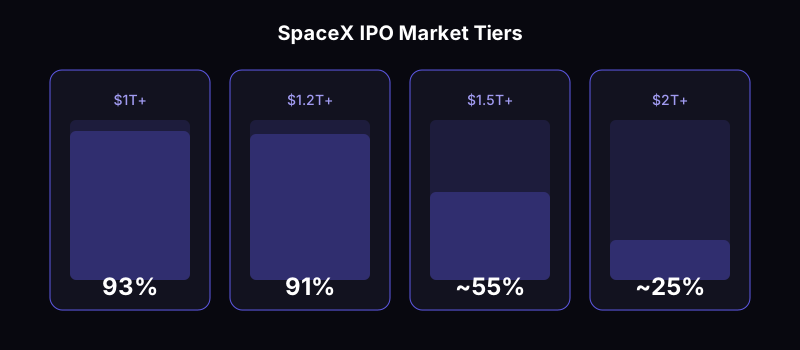
The SpaceX IPO might be the single most traded prediction market event of 2026. Right now on Polymarket, over $845K in volume has flowed into markets asking whether SpaceX will close its IPO above $1 trillion, $1.2 trillion, or even higher. The "above $1T" contract is sitting at 93% yes. The "$1.2T" contract is at 91%.
Those numbers tell a story. And if you know how to read prediction markets, there's real money to be made here.
Why the SpaceX IPO Is a Prediction Market Goldmine
Most IPOs generate buzz. SpaceX generates a gravitational field. This isn't just another tech company going public. It's the company that made reusable rockets work, that's building Starlink into a global internet provider, and that Elon Musk has kept private for over two decades.
When a company this significant finally hits public markets, prediction traders pay attention. Here's why this event is particularly interesting for prediction market strategy:
The certainty premium is real. When a market sits at 93% yes, most people think there's nothing left to trade. They're wrong. The question isn't whether SpaceX will be worth $1 trillion. The question is whether you can find edge in the details: the exact closing price, the timing, the secondary markets that form around it.
Multiple correlated markets exist. Polymarket doesn't just have one SpaceX market. There are tiered market cap questions ($1T, $1.2T, $1.5T, $2T), timing markets, and related markets around Starlink valuation and Musk's net worth. Smart traders play the spread between these.
Volatility spikes around catalysts. Every SEC filing, every analyst note, every Musk tweet can move these markets 5-10% in minutes. If you're positioned correctly, or if you're copying someone who is, that volatility is profit.
The Prediction Market Trading Strategy Nobody Talks About
Here's what experienced prediction market traders actually do with events like the SpaceX IPO. It's not what most beginners expect.
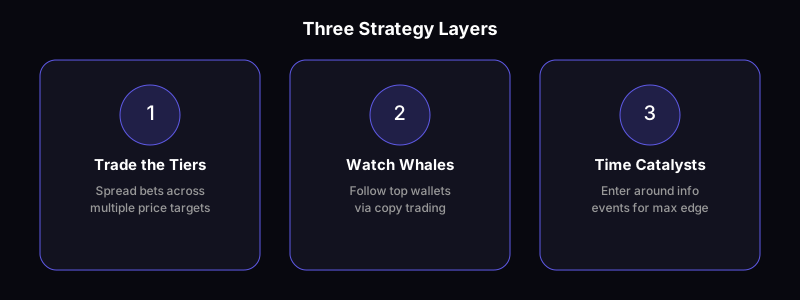
1. Trade the Tiers, Not the Headline
The "$1T or above" market at 93% has almost no upside. You're risking 93 cents to make 7. But look at the higher tiers. The $1.5T market might be at 60%. The $2T market might be at 25%. These are where real risk/reward lives.
The strategy: build a position across multiple tiers based on your conviction. If you think SpaceX will absolutely crush it, load up on the higher tiers where the odds still offer meaningful payoff. If you think the hype is overblown, short the upper tiers while going long on the base.
2. Watch the Whale Wallets
On Polymarket, every trade is on-chain. That means you can literally see what the biggest, most successful traders are doing. When a wallet that's historically profitable in financial markets starts loading up on SpaceX positions, that's a signal.
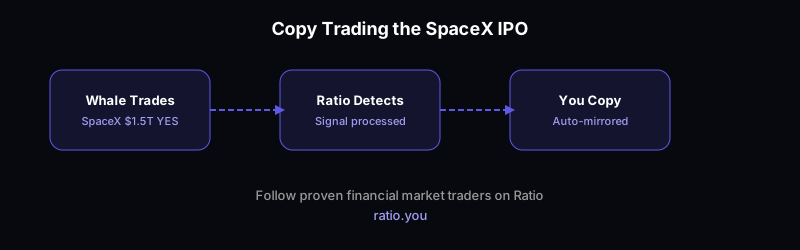
The problem? Manually tracking wallets is painful. You need to check addresses, cross-reference trade history, filter out noise. This is exactly why tools like Ratio exist. Instead of spending hours on blockchain explorers, you can follow proven traders and automatically mirror their SpaceX plays.
3. Time Your Entry Around Information Events
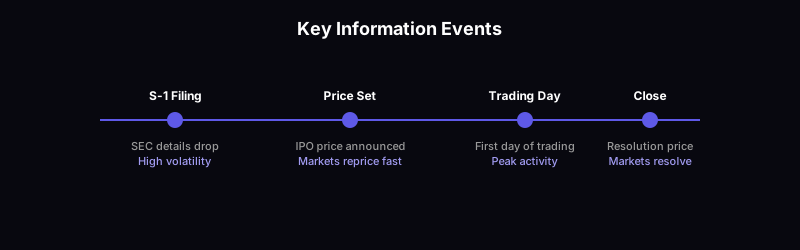
Prediction markets aren't like stocks where you buy and hold forever. They resolve. That means timing matters enormously. The SpaceX IPO markets will move most around:
- SEC S-1 filing details
- Pricing announcements
- First day of trading
- End-of-day closing prices
Each of these creates a window where the market reprices rapidly. Getting in before the reprice (or getting out before a reversal) is where the real money is made.
How Copy Trading Changes the Game
Let's be honest: most people reading this aren't full-time prediction market traders. You have a job, a life, other things going on. You can't sit and watch SpaceX IPO markets all day waiting for a whale to move.
This is where copy trading on prediction markets becomes genuinely powerful.
The concept is simple. Find traders who have a proven track record on financial markets (IPOs, commodities, macro events). Follow them. When they trade the SpaceX IPO markets, you trade too. Automatically.
Several platforms are trying to crack this, with different approaches:
Polycule focuses on Polymarket analytics and lets you browse wallet performance. It's useful for research, but it's more of a data tool than a trading platform. You still have to execute trades yourself.
Polygun offers some tracking features, but the experience is clunky and it's really built for power users who already know what they're doing.
Kreo has been building out social features, though their copy trading is still fairly basic.
Stand.trade takes a different approach with their own platform, but you're limited to their markets rather than having access to the full Polymarket ecosystem.
Then there's Ratio, which is specifically built for this use case. It's a mobile app where you can find top-performing wallets, see their full trade history, and copy their positions with a tap. The social layer means you're not just blindly following addresses; you're part of a community that discusses why certain traders are worth following.
For something like the SpaceX IPO, the difference matters. You want to follow traders who have edge specifically in financial/IPO markets, not someone who's great at politics but has no read on tech valuations. Ratio's filtering makes that possible.
Real Numbers: What the SpaceX Markets Are Telling Us
Let's break down what the current Polymarket odds actually mean in dollar terms.
If you buy "SpaceX IPO above $1T" at 93 cents:
- You make 7 cents per share if it resolves yes
- You lose 93 cents per share if it resolves no
- That's a 7.5% return if you're right
If you buy "SpaceX IPO above $1.5T" at, say, 55 cents:
- You make 45 cents per share if yes
- You lose 55 cents per share if no
- That's an 81.8% return if you're right
The math is straightforward, but the hard part is figuring out which tier represents the best risk-adjusted bet. This is where prediction market trading strategy gets interesting, and where following experienced traders adds the most value.
Some of the best wallets on Polymarket aren't just making one bet. They're constructing portfolios across the tiers, hedging their positions, and adjusting as new information comes in. By copy trading these wallets through Ratio, you essentially inherit their strategy without needing to understand the mechanics yourself.
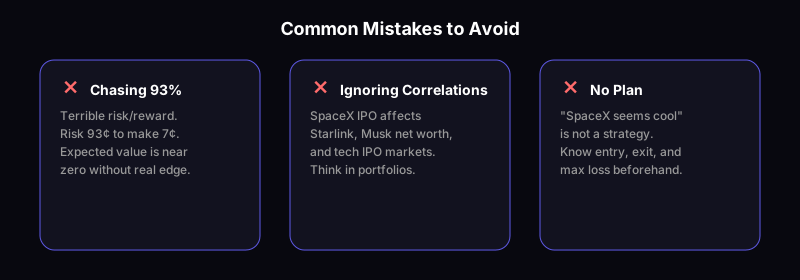
Common Mistakes to Avoid
Don't Chase the 93% Market
It feels safe. It's not. You're accepting terrible risk/reward for the comfort of "probably right." In prediction markets, the expected value of a 93% contract priced at 93 cents is essentially zero. You need an actual edge to profit there.
Don't Ignore Correlated Markets
If SpaceX IPO goes well, what else moves? Starlink-related markets, Musk net worth markets, maybe even broader tech IPO markets. Think in portfolios, not individual bets.
Don't Trade Without a Plan
"SpaceX seems cool, I'll buy some" is not a strategy. Know your entry, your exit, and your maximum loss before you click anything. Or, let someone with a plan trade for you via copy trading.
Getting Started: From Zero to SpaceX Trade
If you're new to prediction markets entirely, here's the fastest path to trading the SpaceX IPO:
- Get funded. Most prediction markets run on USDC (a stablecoin pegged to the US dollar). You'll need to get some into a compatible wallet. Ratio makes this straightforward with built-in funding options.
- Research the markets. Look at the different SpaceX tiers on Polymarket. Read the resolution criteria carefully. Understand exactly what needs to happen for each market to resolve yes or no.
- Find traders to follow. Instead of jumping in blind, spend some time on Ratio browsing wallets that specialize in financial markets. Look at their historical accuracy, their average position size, and how they've performed on similar IPO/valuation markets.
- Start small. You don't need to bet your rent money. Even $50-100 across a few positions lets you learn the mechanics while having skin in the game.
- Watch and learn. Pay attention to how the traders you're following adjust their positions as new information comes out. That pattern recognition is worth more than any amount of theoretical knowledge.
The Bigger Picture
The SpaceX IPO is one event. But the strategy applies everywhere. Prediction markets are creating a new asset class where you can trade on literally anything: politics, sports, economics, technology, culture. The traders who build systematic approaches, who use tools like copy trading to leverage collective intelligence, who manage risk properly, those are the ones who consistently profit.
Whether you're here for the SpaceX IPO specifically or you're looking to build a longer-term prediction market trading strategy, the principles are the same: find edge, manage risk, and don't try to do everything alone.
Ratio is built for exactly this. It's the social layer that prediction markets have been missing. Instead of sitting alone staring at order books, you're trading alongside a community, following proven wallets, and learning from every position.
The SpaceX IPO will resolve one way or another. The question is whether you'll be positioned when it does.
Get Started
Ready to start copy trading?
Download Ratio and follow the best traders on Polymarket. Available on iOS and Android.