
What Is a Prediction Market? A Beginner's Guide for 2026
Learn what prediction markets are, how they work, and why millions of people are trading on real-world events in 2026. From alien disclosure odds to global elections, here's everything you need to know.
You've probably heard people talking about prediction markets. Maybe a friend mentioned they "bought shares" in whether aliens would be confirmed by the government. Maybe you saw a viral tweet about crude oil hitting $100 and someone saying "I'm up 40% on Polymarket."
And you thought: what is any of this?
Fair question. Prediction markets have exploded over the past two years, but the concept still confuses a lot of people. This guide breaks down exactly what a prediction market is, how prediction markets work, and why 2026 might be the best time to start paying attention.
What Is a Prediction Market, Exactly?
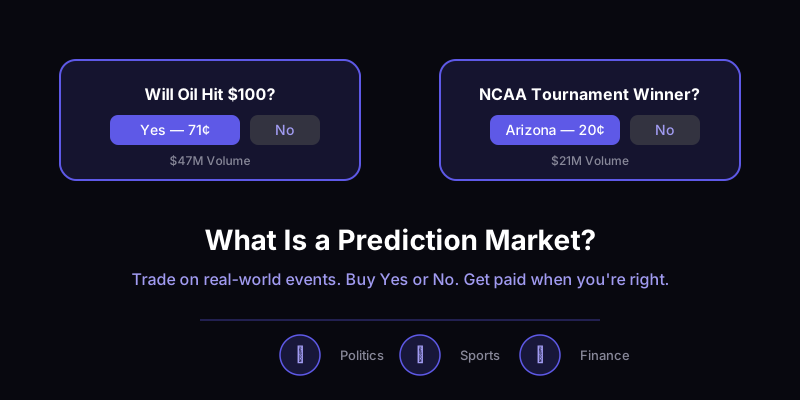
A prediction market is a platform where you trade on the outcome of real-world events. Instead of buying stocks in a company, you're buying shares in a question like:
- Will crude oil hit $105 by the end of March?
- Will Arizona win the 2026 NCAA Tournament?
- Will US forces enter Iran by December 31?
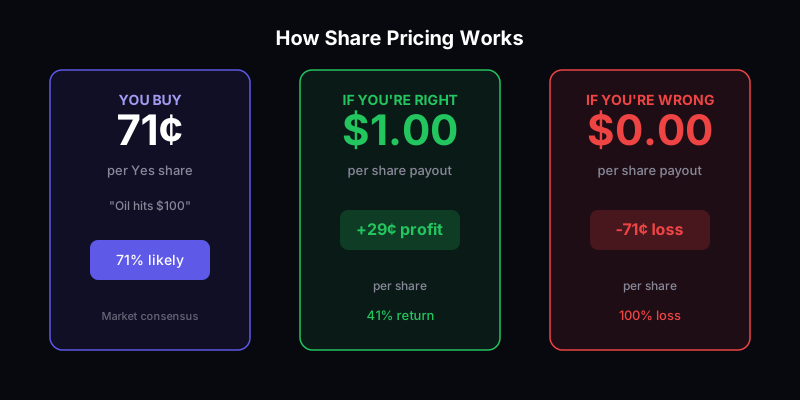
Each question has "Yes" and "No" shares. If you think something will happen, you buy Yes. If you think it won't, you buy No. Shares are priced between $0 and $1, and that price reflects the market's collective estimate of the probability.
If crude oil hitting $100 by end of March is trading at $0.71, the market thinks there's roughly a 71% chance it happens. If you disagree, you trade.
When the event resolves, winning shares pay out $1. Losing shares pay $0. The difference between what you paid and $1 is your profit.
How Do Prediction Markets Work?
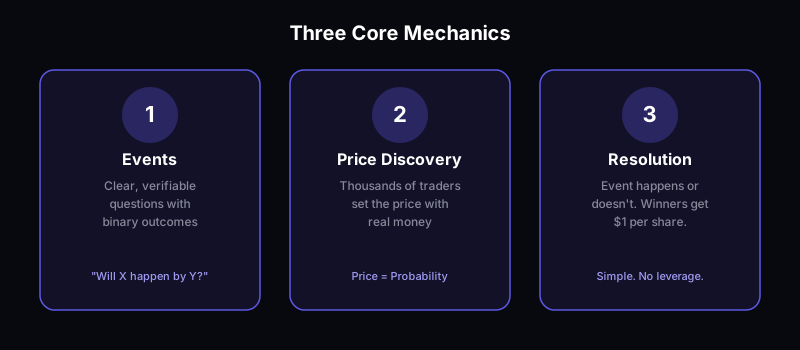
Understanding how prediction markets work comes down to three core mechanics:
1. Events and Outcomes
Every market is built around a specific, verifiable question. "Will X happen by Y date?" The clearer the question, the better the market. Ambiguous questions lead to disputes, which is why the best platforms spend serious effort on resolution criteria.
2. Price Discovery Through Trading
This is where prediction markets get interesting. The price of a share isn't set by an algorithm or an expert panel. It's set by thousands of traders putting real money behind their beliefs. When new information drops, like a geopolitical development or a surprise earnings report, prices shift in real time.
Right now on Polymarket, the market for US forces entering Iran by year-end sits at 67%. That number moves every time there's a headline about the Strait of Hormuz, oil sanctions, or diplomatic talks. It's like a living, breathing probability engine.
3. Resolution and Payout
When the deadline arrives or the event happens, the market resolves. If you held the right side, you get $1 per share. Simple as that. No complicated options chains, no leverage calculations, no margin calls.
Why Are Prediction Markets So Popular in 2026?
A few things converged to make prediction markets mainstream:
Real events people care about. Nobody gets excited about abstract financial instruments. But "will there be alien disclosure this year?" or "who wins the NCAA tournament?" Those are conversations people are already having. Prediction markets just let you put money where your mouth is.
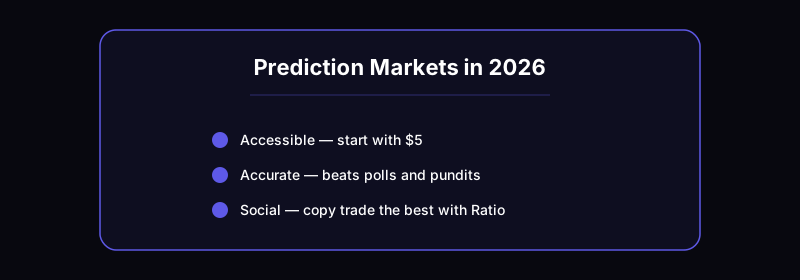
They're surprisingly accurate. Academic research has consistently shown that prediction markets outperform polls, pundits, and expert panels at forecasting. When thousands of people have skin in the game, the collective estimate tends to be remarkably close to reality.
Low barrier to entry. You don't need $25,000 or a brokerage account. Many prediction market platforms let you start with as little as $5-10 using crypto. You can buy a few shares, watch how markets move, and learn without risking much.
The 2024 election proved it. Polymarket's election markets were more accurate than virtually every major poll. That moment put prediction markets on the map for millions of people who'd never heard of them.
What Can You Trade on a Prediction Market?
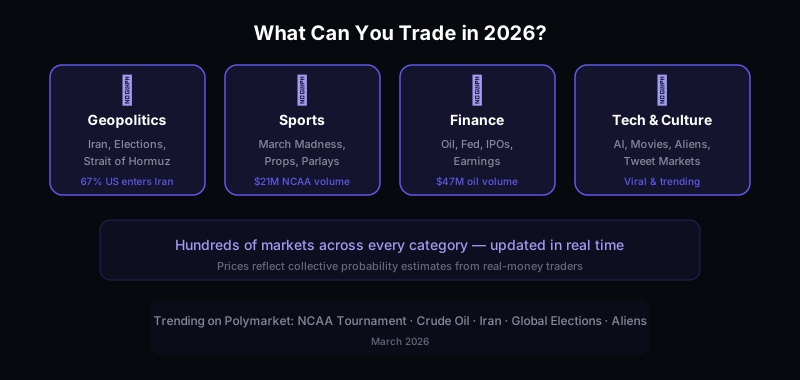
The range of markets available in 2026 is genuinely wild. Here's a snapshot of what's trending right now:
Geopolitics: Iran tensions, Strait of Hormuz shipping disruptions, US military operations, Cuba relations, Slovenia and French elections. These markets move fast when news breaks.
Sports: March Madness brackets are massive right now. Arizona and Michigan are the favorites for the 2026 NCAA Tournament, with $21M+ in volume. You can also find markets on individual games, player props, and season outcomes.
Finance and Commodities: Crude oil price targets, Fed rate decisions, earnings surprises, IPO dates. If it moves markets on Wall Street, there's probably a prediction market for it.
Culture and Tech: AI milestones, movie box office performance, tech company announcements, even tweet markets where you predict what public figures will post about.
The Weird Stuff: Alien disclosure, celebrity events, weather predictions. Some of the most entertaining markets are the ones nobody expected.
How to Get Started with Prediction Markets
If you're ready to try it out, here's the practical path:
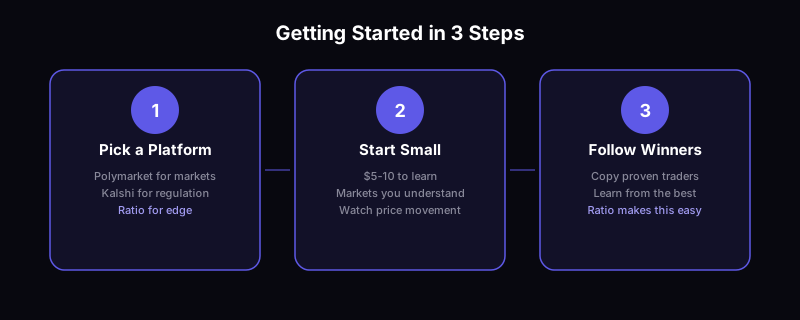
Step 1: Pick a Platform
The biggest name is Polymarket, which runs on blockchain and uses USDC (a cryptocurrency pegged to the US dollar). Kalshi is the regulated US alternative. There are others, but these two dominate.
The challenge with all of them? You're on your own. You see hundreds of markets, price charts, and order books, but no guidance on what to actually trade or who's good at it.
Step 2: Start Small and Learn
Don't deposit $500 on day one. Start with a small amount, pick markets you actually understand, and watch how prices move. The best traders in prediction markets aren't the ones with the most money. They're the ones with the best information and judgment.
Step 3: Follow Smart Traders
This is where prediction markets in 2026 are fundamentally different from even a year ago. Copy trading has arrived. Instead of figuring everything out yourself, you can find traders with proven track records and follow their positions.
Think about it: on Polymarket alone, there are wallets that have turned small stakes into six figures. The data is public. The question is whether you can find those wallets, analyze their strategies, and act fast enough when they make a move.
That's exactly what Ratio is built for. It tracks top-performing wallets across prediction markets, shows you their performance history, and lets you copy their trades. If you're new to prediction markets, starting by following proven traders is genuinely the smartest move you can make.
Are Prediction Markets Legal?
This depends on where you live. In the US, Kalshi is CFTC-regulated and fully legal. Polymarket is available to US users with some restrictions (they can't trade certain markets). Globally, prediction markets operate in a gray area in many jurisdictions, though the trend is toward more regulation and legitimacy.
The key development in 2025-2026 has been growing regulatory clarity. More countries are creating frameworks for event contracts, and mainstream financial institutions are starting to take prediction markets seriously.
Common Mistakes Beginners Make
Trading on emotion. You want your team to win, so you buy Yes at an inflated price. Prediction markets reward objectivity, not hope.
Ignoring liquidity. Some markets have thin order books. If you're buying into a market with low volume, you might not be able to exit when you want to.
Overconcentrating. Putting all your capital into one market is gambling, not trading. Spread across different categories and timeframes.
Not following the smart money. Public wallet data exists for a reason. Ignoring what the top traders are doing is like playing poker without looking at the board. Tools like Ratio make this dramatically easier.
The Bottom Line
Prediction markets are one of the most interesting developments in both finance and information. They give you a way to trade on what you know about the world, not just about companies. They reward good judgment. And in 2026, they're more accessible than ever.
If you're just getting started, the combination of starting small, focusing on markets you understand, and using Ratio to follow proven traders will put you ahead of 90% of newcomers. The information edge in prediction markets is real, and the tools to capture it are finally here.
Get Started
Ready to start copy trading?
Download Ratio and follow the best traders on Polymarket. Available on iOS and Android.